
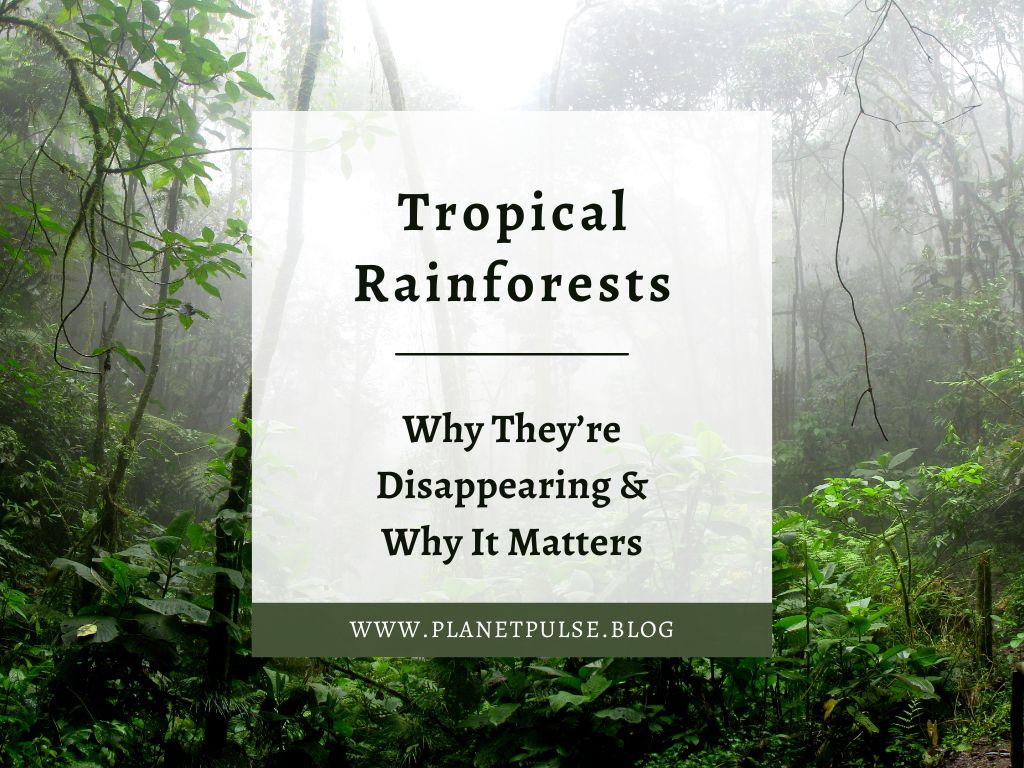
Tropical rainforests are some of the most extraordinary ecosystems on Earth. Despite making up a very little portion of the planet’s geographical area, they are home to more than half of all plant and animal species.
Millions of people are sustained by these forests, which also control rainfall, moderate the temperature, store enormous amounts of carbon as well as support indigenous tribes whose cultures and means of subsistence are closely linked to the forest. However, despite their significance, tropical rainforests are disappearing at a startling rate, with far-reaching consequences.
This article explores what tropical rainforests are, what makes them unique, the main causes behind rainforest loss and why it matters.
In this Article
What Are Tropical Rainforests?
Tropical rainforests are lush, warm and humid woodlands found near the equator, with year-round abundance of rainfall and intense sunlight. Because these rainforests receive about 1,800 to 2,500 mm of rain on average each year, exceptional levels of biodiversity are supported. The towering, broad-leaved evergreen trees that dominate them create a multi-layered canopy, each of which is home to a unique community of plants, insects, birds and mammals.
Geographically, tropical rainforests are concentrated in three major regions:
- The Amazon Basin in South America: Has an area of almost 6 million square km. It is the biggest continuous tropical rainforest. It is mostly found in Brazil, yet a sizable percentage also spreads to Peru, Colombia and other nearby nations.
- The Congo Basin in Central Africa: Is the second-largest tropical rainforest. This forest is mostly found in the Democratic Republic of the Congo but also extends into Cameroon, Gabon and other countries in central Africa. It is roughly 1.7 million square km in size.
- The Rainforests of Southeast Asia: Can be found throughout Southeast Asia, especially in areas of Indonesia, Malaysia and other mainland nations as well as on islands like Borneo and New Guinea.
Tropical rainforests are especially notable for how quickly and effectively nutrients cycle through the ecosystem. Nutrients are quickly absorbed by plants rather than being stored in the soil because breakdown is accelerated by warm temperatures and consistent moisture. This creates a delicate balance that is easily disrupted when the forest is cleared or degraded. Without the protective canopy and continuous recycling of organic matter, the soils beneath rainforests can quickly become infertile due to their often surprisingly low nutrition levels.
Moreover, tropical rainforests are also ecologically complex. Every level of the forest, from the dark, humid forest floor to the emergent layer that soars above the canopy, is home to species that have adapted to its particular environment. Large mammals forage for food in the understory layer, frogs take refuge in rainwater-filled bromeliads and epiphytes cling to branches high above the ground. Many species are endemic, which means they can’t be found anywhere else on Earth, and some are still unknown.
Tropical rainforests are cultural landscapes that go beyond their natural characteristics. These forests provide food, medicine, shelter and a sense of spiritual identity to millions of indigenous people who live in or close to them. Understanding and preserving rainforest ecosystems depend on their knowledge systems, which have been moulded by generations of close interaction with the land.
In short, tropical rainforests are more than simply woods. They are complex, living systems that maintain human cultures, support biodiversity and regulate the climate. The stability of the natural processes that support life on Earth is threatened by their extinction, which signifies the loss of much more than just trees.
What Makes Tropical Rainforests Unique?
Tropical rainforests thrive in areas with year-round humidity, steady warmth and heavy rainfall. These conditions provide the ideal setting for life to thrive. Millions of species, many of which are unique to Earth, are supported by layers of vegetation, which range from the tall emergent trees to the thick understory. This biodiversity has a purpose in addition to being aesthetically pleasing. From pollinating plants to recycling nutrients in the soil, every organism contributes to the ecosystem’s equilibrium.
Additionally, rainforests offer vital ecosystem functions. By storing carbon in their biomass, they contribute to climate regulation. They also keep rivers and freshwater systems healthy, prevent soil erosion and have an impact on rainfall patterns across continents.
The Main Drivers Behind Rainforest Loss
Tropical rainforests are disappearing due to a combination of climate-driven forces and human activity. According to recent data, the world lost 6.7 million hectares of tropical primary rainforest in 2024, which is the most in at least 20 years. This is an 80% rise in deforestation than in 2023. For the first time in history, over half of all destruction in tropical primary forests was caused by fires rather than agriculture.
Deforestation is still mostly caused by agricultural expansion. Soy cultivation, palm oil plantations and cattle ranching all need the clearing of forests. Palm oil production alone has contributed significantly to the loss of forests in Southeast Asia. Between 2000 and 2018, clearance for palm oil accounted for 7% of the world’s deforestation.
Moreover, forests are still being degraded by logging, both legal and illegal. Road construction made possible by the exploitation of timber opens up previously unreachable places, resulting in additional clearing and settlement. Another significant pressure is mining. The extraction of rare earth minerals, gold, bauxite and oil from beneath rainforest soils leaves behind fragmented habitats and contaminated streams.
Infrastructure development also plays a major role as intact forest landscapes are carved away by roads, dams and new communities, making forests more vulnerable to exploitation. These demands are increased by climate change. 2024 was the hottest year on record, and severe drought conditions made it more difficult to contain fires due to El Niño and climate change.
Where Rainforests Are Disappearing Fastest
The most famous example of rainforest loss is still the Amazon Rainforest. Despite the fact that deforestation in Brazil decreased by 30.6% between August 2023 and July 2024 as a result of increased enforcement and reinstated safeguards for indigenous areas, numerous fires largely counteracted this improvement. Drought-related fires still pose a threat to the area, despite the 6,288 square kilometres cleared during this time representing the lowest annual loss in nine years.
Additionally, with 4.7% of its primary forest losing in 2024, Nicaragua had the highest percentage of primary forest loss in Central America, with the majority of that loss occurring within the Bosawás Biosphere Reserve.
Why Rainforest Loss Matters
The climate is significantly impacted by the loss of tropical rainforests. As enormous carbon sinks, forests take up carbon dioxide from the atmosphere. This carbon is released when forests are burned or removed.
Moreover, rainfall patterns both locally and globally are affected by the loss of rainforests. Through a process called evapotranspiration, forests recycle moisture, contributing to the production of rainfall on entire continents. Droughts become more common and severe when forests disappear, which has an impact on food security, water supplies and agriculture.
Biodiversity loss is another serious problem. Numerous species are at risk of extinction due to forest degradation. Due to habitat loss, many plants and animals are already in danger of going extinct, and the loss of even one species has the potential to upset entire ecosystems. Additionally, genetic variety found in rainforests is vital for scientific study, agriculture and medicine.
Deforestation is a human rights disaster as well as an environmental problem for indigenous peoples. The destruction of forests frequently results in cultural erosion, land grabbing and displacement. It has been demonstrated that one of the best ways to preserve forests is to protect indigenous land rights.
Economically, the short-term benefits of deforestation are outweighed by the long-term risks. Industries including tourism, fishing and agriculture are at risk due to forest loss. Also, as habitat is destroyed, wildlife and humans come into closer contact, increasing the risk of zoonotic diseases.
What’s Being Done to Protect Rainforests
There are indications of improvement despite the concerning patterns. Strong governance, enforcement and indigenous land conservation can have a significant impact, as evidenced by Brazil’s recent decrease in deforestation.
By 2030, international accords like the Glasgow Leaders’ Declaration on Forests and Land Use seek to stop and reverse the loss of forests. With 17 of the 20 nations with the greatest primary forest areas seeing greater forest loss now than when the pact was signed, current trends indicate that the globe is well off course.
Conservation organisations are still very important. For instance, throughout the last 32 years, Rainforest Concern has contributed to the protection of 2.2 million hectares of vulnerable forest.
Apart from this, sustainable agricultural practices such as agroforestry, shade-grown crops and certification programs are examples of sustainable agricultural techniques that provide alternatives to harmful land use. Although enforcement is still uneven, corporate commitments to zero-deforestation supply chains are growing.
One of the most promising strategies is community-led conservation. Long-term success depends on supporting the leadership of indigenous and local communities, who frequently have the best record of forest protection.
Conclusion
The rate at which tropical rainforests are vanishing endangers biodiversity, human well-being and climate stability. The record-breaking loss of forests in 2024 demonstrates the severity of the situation. However, forests may rebound when conservation efforts, strong policies and indigenous leadership are given top priority.
For the earth to be habitable, rainforests must be preserved. Whether these ecosystems continue to flourish or become historical narratives will depend on the decisions taken now.






Leave a Reply