Understanding how energy moves through an ecosystem is essential for grasping how life on Earth is organised. Every organism, whether a plant, predator, or decomposer, depends on others for survival. Two models help us visualise these relationships. Which are food chains and food webs. Although they’re often mentioned together, they have different purposes. One offers simplicity, while the other reveals the true complexity of nature.
This article explores both concepts in depth, showing how they work, why they matter, and how they help us understand biodiversity and ecosystem stability.
In this Article
What Is a Food Chain?
The most basic representation of energy transfer within an ecosystem is a food chain. It follows a single, direct route that starts with a producer, which is typically a photosynthetic organism like a plant or algae and ascends through various consumers.
In a simple meadow, for instance, sunlight drives the growth of grass. A rabbit eats grass, accumulating energy in its tissues. Then a fox hunts the rabbit, passing that energy further up the chain. A trophic level is what each step is called, and each level signifies a different phase in the flow of energy.
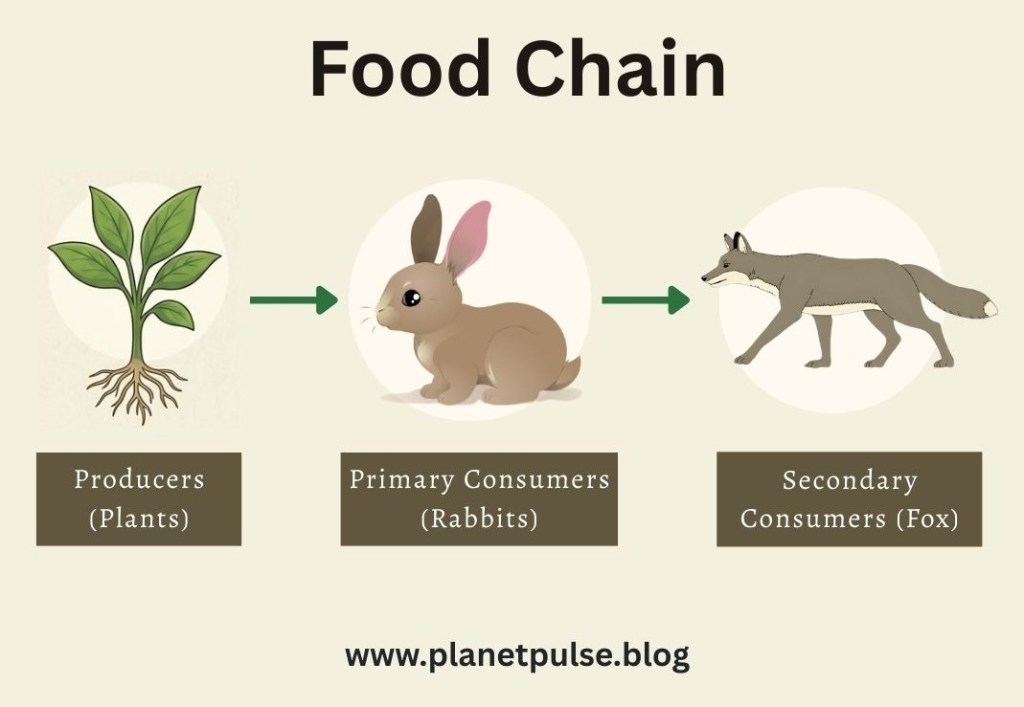
Food chains are important as they simplify complexity and enable us to concentrate on the basic concept that energy transfers from one organism to another.
However, this simplification is also a limitation. This is because in nature, organisms rarely depend on a single food source, and predators typically do not target just one kind of prey.
What Is a Food Web?
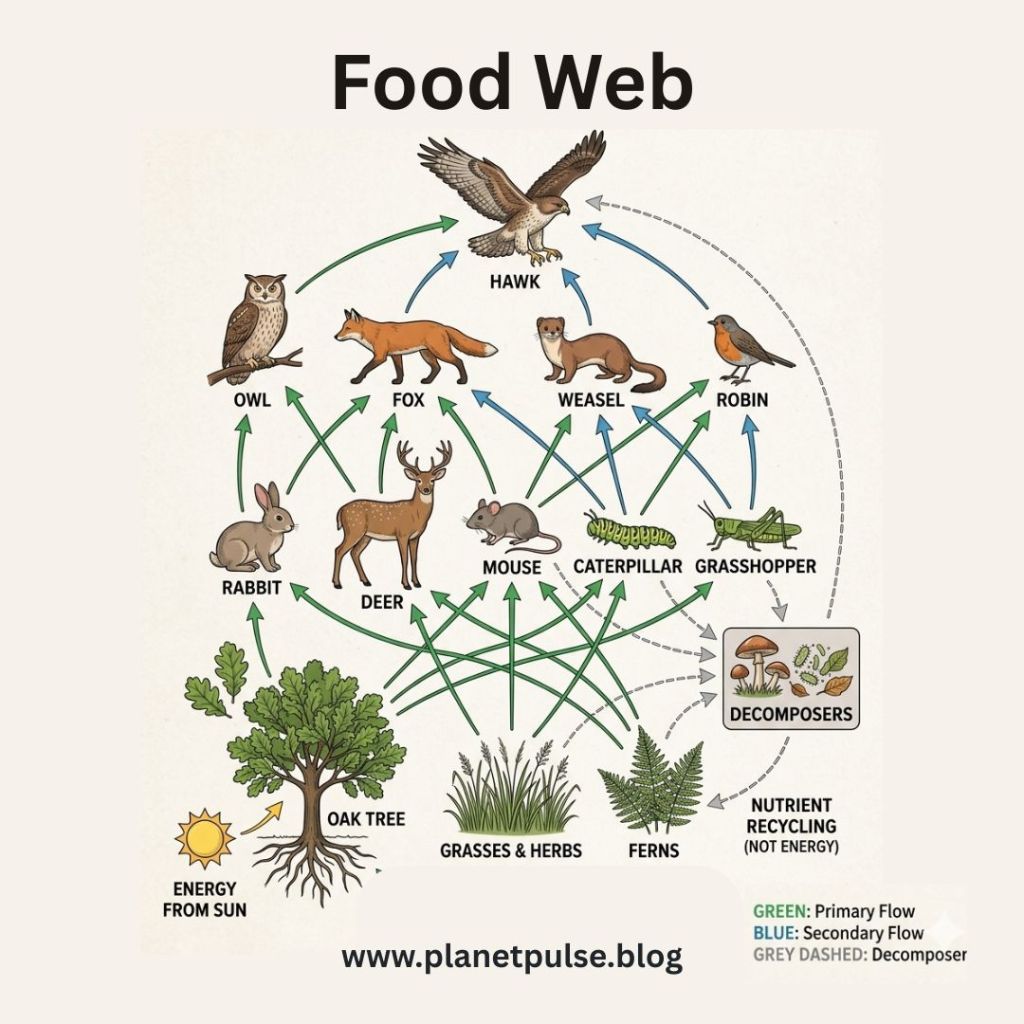
Instead of displaying a single pathway, a food web shows the overlap and connections between several chains. For instance, a mouse may consume seeds, fungus, berries, and insects in a wooded setting. Owls, foxes, snakes, and even larger birds may then consume it.
In turn, those predators may consume small birds, voles, or rabbits. In the meantime, dead matter is broken down by decomposers like fungi and bacteria, which replenish the soil with nutrients and promote plant development.
All of these interactions are simultaneously captured by a food web. It demonstrates that ecosystems are dynamic, interrelated groups rather than linear systems. Ecosystems are resilient because of their interconnection, as one species disappears, another may be able to fill its ecological role, preventing collapse.
Key Differences Between Food Chains and Food Webs
Despite their similarities, food chains and food webs differ in a number of significant ways. The most evident difference is complexity. A food web is a dense network of overlapping chains, whereas a food chain is a single channel of energy transfer.
Accuracy varies as a result of this structural variation. Food webs represent the actual diversity of feeding connections in nature, whereas food chains simplify reality to facilitate learning.
Ecosystem stability is another significant difference between them. This is because there is only one path for energy to travel through in a food chain. The chain breaks if one species becomes extinct. On the other hand, a food web displays several paths, as predator may switch to a different species of prey if it loses one. This flexibility helps ecosystems absorb disturbances.
Additionally, food webs enable organisms to play several trophic functions. For instance, an omnivore like a bear might eat carrion, fish, berries, and insects. It would be confined to one location in a food chain, but it can present at multiple levels at once in a food web.
Finally, food webs offer a more realistic picture of energy flow, showing how energy moves not just upward but across and between species groups. This makes them far more useful for ecological research and conservation planning.
Why Food Webs Matter More in Ecology
Food webs are the models ecologists use to understand how ecosystems work, even though food chains are great teaching tools. They make keystone species, which are species that hold an ecosystem together as without them, the ecosystem wouldn’t function. Removing a keystone species can trigger a trophic cascade, where changes at one trophic level ripple through the entire ecosystem.
Scientists can evaluate ecosystem resilience with the aid of food webs. In general, a highly interconnected web with several feeding links is more stable. Others can make up for a reduction in one species. A simpler or deteriorated web, on the other hand, is more likely to fail.
Biodiversity is crucial because of this. An ecosystem can create more linkages and become more stable when it has more species.
Human Impacts on Food Chains and Food Webs
Human activities often disrupt the delicate balance of feeding relationships. These impacts include:
- Habitat destruction: Removes food sources and shelter.
- Plastic pollution: can poison organisms at the base of the web, such as plankton or plants.
- Overfishing: removes key predators or prey, reshaping entire marine ecosystems.
- Climate change: alters temperature, rainfall, and seasonal patterns, affecting when and where species feed.
When one species disappears, especially a predator or keystone species, the effects can be drastic. For example, the decline of sea otters, allowed sea urchin populations to explode, which in turn devastated kelp forests. In contrast, the reintroduction of wolves to Yellowstone restored balance by controlling elk populations, allowing vegetation and other species to recover.
These examples show how tightly woven food webs are, and how easily they can unravel when disrupted.
How Scientists Use Food Webs in Conservation
Food webs help researchers identify which species are the most vulnerable, which ones hold ecosystems together, and which interactions are essential for long‑term stability. By understanding these relationships, conservationists can design more effective restoration projects, predict the consequences of species loss, and prioritise actions that support biodiversity.
In addition, food web analysis also plays a key role in rewilding, where species are reintroduced to restore natural processes. Also, by mapping feeding relationships, scientists can anticipate how reintroductions will affect the wider ecosystem.
Frequently Asked Questions (FAQs)
Can a species appear in multiple food chains?
Yes. Most species have varied diets and predators, so they naturally appear in several food chains that overlap within a food web.
Why are food webs more accurate than food chains?
Food webs capture the full range of feeding relationships, showing how organisms interact across multiple trophic levels rather than following a single pathway.
What happens if a top predator disappears?
The loss of a top predator can trigger a trophic cascade, where prey populations grow unchecked and disrupt plant communities, herbivores, and other predators.
Are humans part of food webs?
Yes. Humans are deeply embedded in food webs as omnivores, consumers, and ecosystem managers whose actions influence species at every trophic level.
What is the role of decomposers in food webs?
Decomposers break down dead organic matter, returning nutrients to the soil or water and supporting the growth of producers at the base of the web.
Do all ecosystems have food webs?
Yes. Whether it’s a rainforest, coral reef, desert, or urban park, every ecosystem contains interconnected feeding relationships that form a food web.
Conclusion
Although they provide varying degrees of knowledge, food chains and food webs both aid in our understanding of how energy flows across ecosystems. Food chains are perfect for learning the fundamentals since they offer simplicity and clarity. Whilst, food webs demonstrate the interdependence of species and the stability of ecosystems, revealing the full complexity of nature. When taken as a whole, they emphasise the significance of interconnection and biodiversity for maintaining life on Earth.
 Planet Pulse
Leave a comment