
One of the most important social and environmental problems that UK households are currently facing is winter energy poverty. Millions of people struggle to keep their houses warm enough as the temperature drops, which puts their health at danger, puts them under financial strain, and creates long-term inequality. This problem is significantly more complicated than just “high energy bills,” as it lies at the nexus of public health, social justice, housing quality, and climate resilience.
When a household cannot afford sufficient heating during the colder months, it is referred to as winter energy poverty. Rising energy costs, inefficient housing, low earnings, and structural disparities that make some groups more susceptible all contribute to this in the UK. Understanding the causes and impacts is essential for anyone working in sustainability, community support, or policy and for households navigating the crisis themselves.
In this Article
What Energy Poverty Really Means
Fuel poverty, as determined by the Low Income Low Energy Efficiency (LILEE) indicator, is a term commonly used by the UK government. A household is considered fuel poor under this criteria if:
- After housing expenses, its revenue is minimal
- The property it resides in has an EPC rating of D or lower.
Energy poverty is more widespread. It includes not being able to pay for all necessary energy services, such as cooking, lighting, heating, and internet access. This is even worse in the winter when heating becomes a health and safety concern, particularly for families with small children, the elderly, and those with disabilities.
Due to the UK’s long, wet winters and outdated housing stock, which is among the least energy-efficient in Europe, even mild cold can cause households to have financial difficulties.
Who Is Most Affected?
Winter energy poverty does not affect everyone equally. Certain groups are more vulnerable than others because:
- Low‑income households spend a larger part of their income on energy, leaving little room for price increases.
- People on pre-payment meters often pay higher tariffs and face the risk of self‑disconnection.
- Private renters in poorly insulated homes have limited control over improvements.
- Older adults and disabled people may need to heat their homes for longer periods.
- Families with young children face additional health risks from cold, damp environments.
- Rural households reliant on oil or LPG heating face volatile fuel prices.
- Migrant households may struggle to access support due to language or digital barriers.
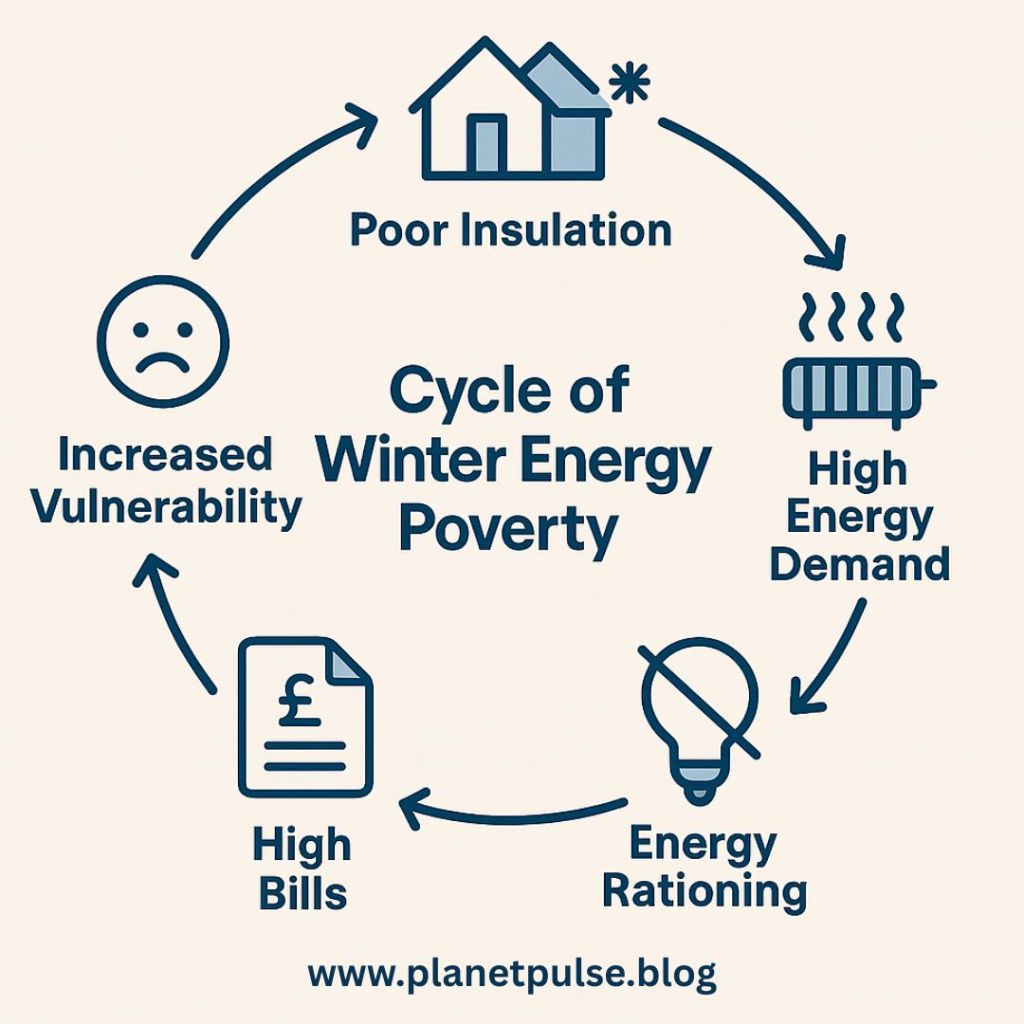
These overlapping vulnerabilities create a cycle where cold homes worsen health, reduce financial stability and deepen inequality
Why Winter Energy Poverty Happens
Winter energy poverty is not caused by individual behaviour. It is the result of long‑standing structural issues, such as:
- Low-quality housing: A large portion of the housing stock in the UK is outdated, inadequately insulated, and drafty. Households need to spend more energy to stay warm since heat escapes quickly.
- High and unstable energy costs: Due to supply limitations and global market swings, prices have reached all-time highs. Many people still cannot afford their bills despite pricing limitations.
- Pre-payment meters policies: Prepayment clients frequently pay extra per unit of energy and run the danger of having their service disconnected if they are unable to top up.
- Low income and welfare cuts: Households have less money to spend due to stagnant wages, growing living expenses, and decreased social assistance.
- Climate change: Increases the frequency of extreme weather events, such as cold snaps, which strain the energy grid and raise the need for heating.
- Policy gaps: Although there are support programs, many of them are complicated, underfunded, or challenging to use. Help-seeking households frequently slip between the gaps.
The Real‑World Impacts of Cold Homes
Cold homes have far‑reaching consequences that affect health, wellbeing, and long‑term life chances.
- Health effects: Damp, cold conditions raise the risk of cardiovascular disease, respiratory ailments, and mental stress.
- Social effects: Because of stigma, people might not invite others into their houses, which makes them feel more alone.
- Educational impacts: Children find it difficult to focus or learn in cold houses, and when families restrict electricity, digital exclusion is worse.
- Economic effects: In order to deal with growing expenses, households may limit heating, forgo meals, or incur debt.
- Environmental impacts: Heating inefficient homes requires more energy, which raises carbon emissions.
These impacts show why winter energy poverty is both a social justice issue and a climate resilience challenge.
How Winter Energy Poverty Is Measured
The LILEE metric concentrates on income and energy efficiency, although it does have limits. This is because the metric falls short of capturing:
- Energy-rationing households
- Individuals living in transitional housing
- Individuals that require a lot of medical energy
- Climate and housing quality variations by region
Because of their distinct policy environments, Scotland, Wales, and Northern Ireland employ distinct definitions. Anyone operating in the UK should be aware of these differences.
Support Available for Households
A number of government initiatives aim to decrease winter energy poverty. This includes:
- Winter Fuel Payment: Pension-age households receive an annual stipend.
- Cold Weather Payment: Triggered when temperatures drop below freezing for seven consecutive days.
- Warm Home Discount: A one‑off discount for eligible low‑income households.
- Energy Company Obligation (ECO4): Funding for insulation and energy‑efficiency improvements.
- Great British Insulation Scheme: Support for basic insulation measures.
- Local authority grants: Vary by region and may include boiler upgrades or emergency support.
While these schemes provide essential relief, many households report barriers such as complex applications or unclear eligibility.
Practical Steps Households Can Take
Although the root causes are structural, there are practical steps that can help households reduce energy use or access support.
- Verify your eligibility for government programs by using the official methods.
- Consult your energy provider about tariff alternatives and payment schedules.
- Make use of inexpensive insulating techniques like thermal curtains or draught excluders.
- Understand your rights as a tenant, including the minimal requirements for energy efficiency.
- Make use of community resources including mutual assistance organisations, warm rooms, and nearby charity.
These steps can provide immediate relief while broader systemic solutions are pursued.
Long‑Term Solutions
Governments, businesses, and communities must work together to end winter energy poverty.
Some of the best long-term solutions include:
- Retrofitting homes at scale is one of the most effective solutions.
- Vulnerable homes would be safeguarded by changing prepayment meter procedures.
- Increasing social tariffs could guarantee low-income families more equitable prices.
- Long-term expenses and emissions are decreased by decarbonising heating through district heating and heat pumps.
- Increasing the authority of local authorities allows for more focused assistance.
- Prioritising vulnerable people during the shift to net-zero is ensured by including energy justice into climate policy.
Warm, secure housing ought to be a basic right rather than a privilege.
Frequently Asked Questions (FAQs)
What’s the difference between fuel poverty and energy poverty?
Fuel poverty is a UK-specific measure based on household income and energy efficiency. Energy poverty is a broader concept that includes access to all essential energy services.
Why has winter energy poverty increased?
Rising energy prices, low household incomes, and poor housing quality have combined to create a perfect storm.
Are prepayment meters more expensive?
Yes. Prepayment customers often pay higher tariffs and face the additional risk of self-disconnection if they cannot top up.
What rights do renters have?
Landlords must meet minimum energy efficiency standards and ensure heating systems are safe, functional, and properly maintained.
How does energy poverty relate to climate change?
Climate change increases extreme weather and energy demand, while inefficient homes contribute to higher emissions, creating a cycle of vulnerability and environmental impact.
Conclusion
In the UK, winter energy poverty is a systemic problem with roots in inequality, poor housing, and unstable energy markets rather than only a seasonal annoyance. More households are at danger of cold, damp houses and the ensuing financial and health consequences as climate change worsens and energy prices rise.
Solving this crisis requires more than short‑term relief. It demands long-term investment in energy efficiency, equitable pricing, and inclusive policy design that gives the most vulnerable people priority. Warm, secure housing ought to be a fundamental entitlement rather than a winter indulgence.
We can end the cycle of winter energy poverty and create a more resilient, equitable future by understanding the cycle, assisting impacted communities, and advocating for structural change.



 Planet Pulse
Leave a comment