
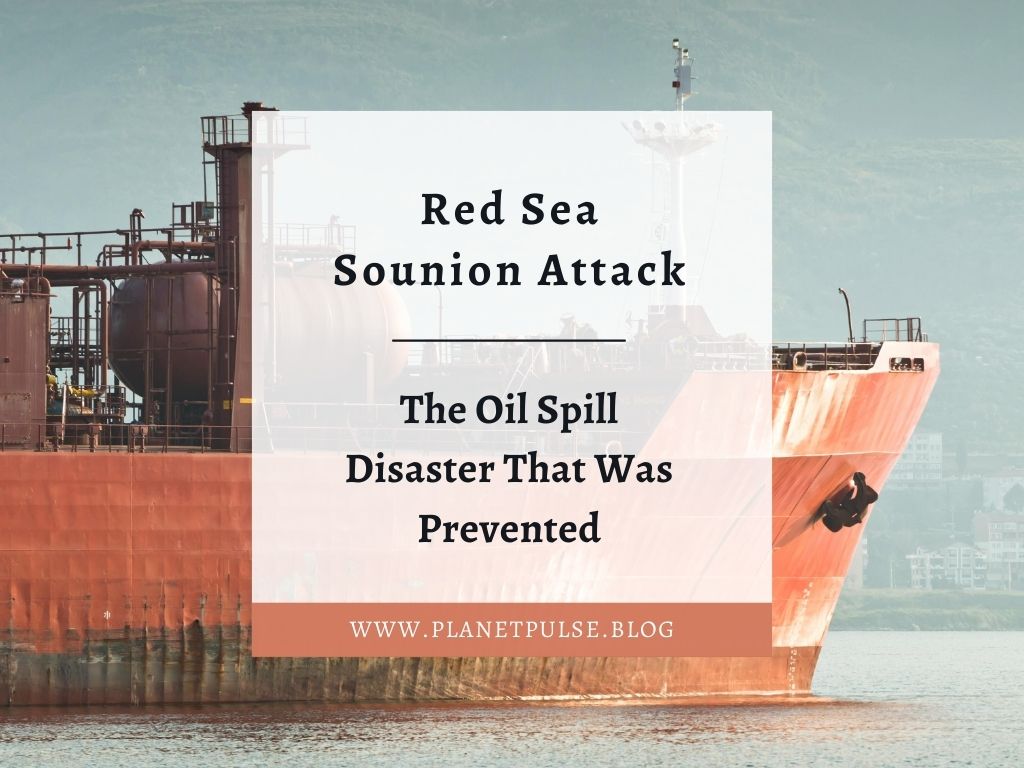
Although the Red Sea has always been a geopolitical hotspot, one of the most severe environmental crises recently occurred there in August 2024. The world directly saw how quickly conflict can turn into an ecological disaster when the Greek-registered oil tanker Sounion was hit by several missiles while in transit. The damage to the tanker, which was transporting almost a million barrels of crude oil, resulted in power outages, fires, and a significant spill that was on the verge of becoming one of the deadliest naval accidents in modern history.
The attack on the Sounion was not an isolated event, it followed months of escalating insecurity that began with the hijacking of the Galaxy Leader in November 2023. However, this was a turning point, which compelled governments, environmental organisations, and maritime authorities to face a long-ignored reality. That is, in addition to being commercial assets, oil tankers are environmental time bombs in conflict zones.
In this Article
What Happened: A Timeline of the Attack
Houthi militants attacked the Sounion on August 21–22, 2024, while it was passing through the Red Sea. According to reports, armed men in small boats began fire after the ship was struck by multiple missiles and drones. The impacts disabled the ship’s power systems and started a fire onboard.
The tanker was left drifting approximately 77–90 nautical miles off the coast of Yemen, near Al Hudaydah.
The immediate repercussions were catastrophic:
- Parts of the ship were consumed by smoke and fire.
- Distress signals were sent out by the crew.
- Oil began to leak into the water.
- The security issue caused a delay in salvage efforts.
The attack triggered global alarm as the oil tanker was carrying up to 150,000 tons of crude oil, equivalent to roughly one million barrels.
Why the Sounion Was So Vulnerable
A substantial cargo of crude oil was transported from the Arabian Peninsula to European markets by the Panamax-class tanker Sounion. Due to its route through the Red Sea, it was right in the middle of a conflict area where commercial ships had been targeted for months.
Its vulnerability was increased by several factors, for instance:
- Predictable transit routes through narrow waters.
- In some areas, there is little naval protection.
- High-value cargo that raises the stakes for the economy and environment.
- Tankers are not designed to survive missile strikes, but rather storms and collisions.
The attack demonstrated how easily a single vessel can become an amplifier for environmental disaster when geopolitical tensions escalate.
The Environmental Impact of a Spill in a Semi‑Enclosed Sea
The Red Sea is a unique marine environment as it is narrow, deep, and semi‑enclosed. Because circulation is limited, pollutants persist far longer than they would in open oceans.
The Sounion incident raised immediate environmental concerns, such as:
- Seagrass meadows, mangroves, and coral reefs are all at risk as oil slicks spread across the ocean.
- Heat‑resilient coral reefs, which are among the most climate‑tolerant in the world, faced smothering and toxic exposure.
- Plankton, the foundation of the food chain, and fish populations were at risk from hydrocarbon poisoning.
- Coastal communities feared contamination of beaches, fisheries, and desalination intakes.
Experts warned that a full hull breach could have caused one of the largest oil spills in recorded history. Even the partial spill was enough to highlight how fragile the Red Sea is in the face of conflict‑driven pollution.
How a Major Disaster Was Ultimately Averted
A combination of quick international collaboration and sheer luck prevented a full-scale environmental disaster despite the attack’s scope and the tanker’s large petroleum cargo. The crew of the Sounion was able to control the onboard fire following the initial strikes long enough for salvage crews to arrive at the ship.
In order to enable expert responders to board the ship, stabilise its power systems, and stop additional structural failure, naval troops guarded the surrounding waterways. The ship was also towed toward safer waters after temporary containment measures were put in place to stop the oil spill from spreading.
This avoided a complete hull breach, which would have resulted in the spilling of hundreds of thousands of tonnes of petroleum into the Red Sea and irrevocable harm to the environment.
Human and Economic Fallout
Environmental damage was just one aspect of the problem. The incident had far-reaching effects on people and the economy:
- Fisheries, which are vital to coastal communities, were at risk of contamination.
- Tourism in neighbouring areas prepared for the ecological and reputational consequences.
- Rerouting vessels resulted in longer trip times and higher fuel usage for shipping businesses.
- The cost of international transportation increased as insurance rates skyrocketed.
- Given the tanker’s substantial oil cargo, the energy prices increased.
The Red Sea is a vital route for international trade. Any disturbance, particularly one involving oil, has an impact much beyond the area.
Why the Response Was So Difficult
Compared to peacetime, responding to an oil leak in a combat zone is far more difficult. A number of systemic flaws were revealed by the Sounion incident. This include:
- Restricted access: Posing security threats to environmental responders and rescue workers.
- Fragmented governance: The Red Sea is surrounded by several countries, each with its own capabilities and priorities.
- Limited regional infrastructure for spill response: there aren’t many specialised ships or equipment repositories.
- Delayed co-ordination: Before operations could start, diplomatic talks were required.
A multinational effort ultimately steadied the ship and avoided a complete spill in spite of these difficulties. In September 2024, the worst-case scenario was avoided when the tanker was safely put under tow.
What the Sounion Incident Revealed
The attack on the Sounion was a wake‑up call for the global community. It revealed several critical truths:
- Environmental security must be integrated into maritime security.
- Oil tankers in conflict zones pose disproportionate ecological risks.
- Regional co-operation is essential as no single country can manage a spill of this scale.
- Prevention is far more effective than cleanup, especially in a semi‑enclosed sea.
- The Red Sea’s ecological resilience has limits, and conflict is pushing those limits dangerously.
The incident also reignited international attention on the broader Red Sea shipping crisis, which had faded from headlines earlier in the year.
Conclusion
The August 2024 attack on the Sounion was not just a maritime security incident but a near‑catastrophic environmental event that exposed the fragility of one of the world’s most important marine ecosystems. It demonstrated how the globe is unprepared for oil spills in conflict areas and how swiftly geopolitical tensions may result in ecological damage.
Whether or not governments, environmental organisations, and marine authorities view this catastrophe as a turning point will determine the future of the Red Sea. Maybe the next tanker won’t have the same luck. It might not be possible to contain the next spill. Furthermore, the ecosystems in the Red Sea might not be able to recover from the next disaster.


 Planet Pulse
Leave a comment