
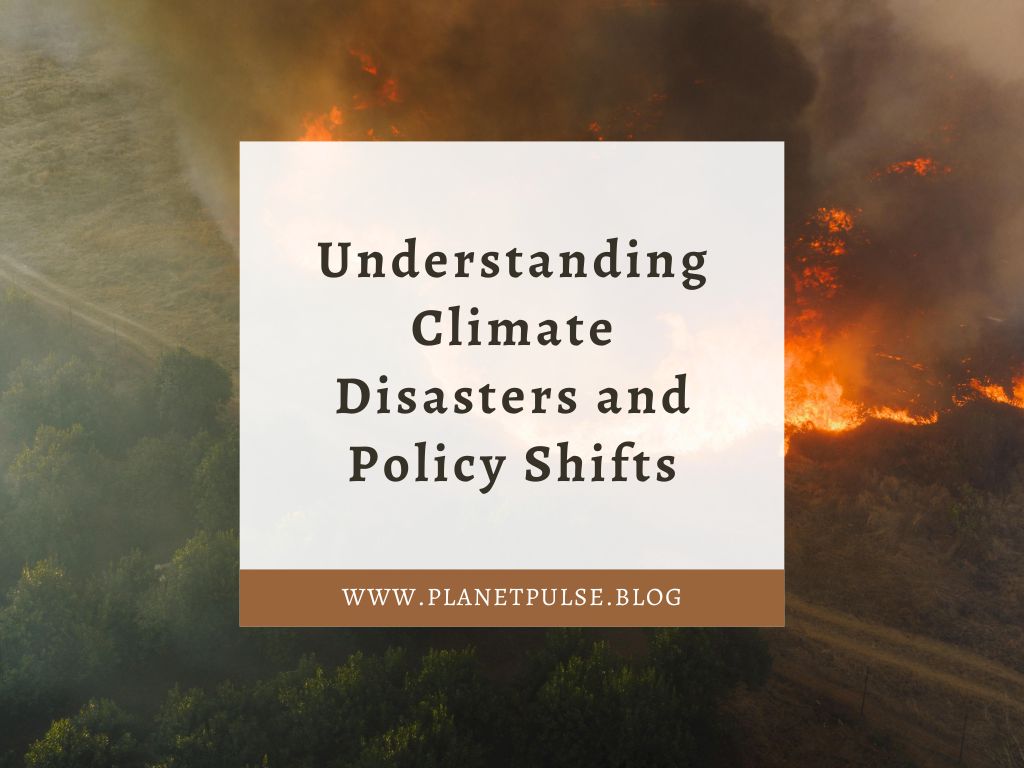
In recent years, the world has witnessed a surge in climate-related disasters, from catastrophic floods in Pakistan to record-breaking wildfires in California and Europe. According to the United Nations, more than 150 significant climate disasters occurred in 2024 alone, emphasising the urgency of global action. These events are not isolated tragedies; they are catalysts reshaping how governments, institutions, and international bodies design sustainability policies.
This article explores how natural disasters are influencing international sustainability legislation, highlighting case studies, challenges, and the future outlook for climate governance.
In this Article
Climate Disasters on the Rise
The economic and human toll of disasters has significantly increased. Between 2001 and 2020, annual disaster costs rose to $180–200 billion, compared to $70–80 billion in the late 20th century. When increasing ecosystem impacts are included, the global cost now exceeds $2.3 trillion annually.
Recent examples include:
- Pakistan floods (2025): More than 700 lives lost, thousands displaced, and critical infrastructure damaged.
- European floods (2021): Germany and Belgium faced unprecedented rainfall, causing hundreds of deaths.
- California wildfires (2023): Destroyed communities and accelerated renewable energy debates.
- Horn of Africa droughts: Triggered famine risks and migration pressures.
These disasters highlight the interconnectedness of climate change, human vulnerability, and policy responses.
Immediate Policy Responses
Governments often respond to disasters with emergency relief, but increasingly, adaptation and resilience are being embedded into long-term strategies. The UNFCCC emphasises the importance of National Adaptation Plans (NAPs), which integrate disaster risk reduction into infrastructure, agriculture, and urban planning.
Examples of immediate responses include:
- Stricter building codes in wildfire-prone regions.
- Flood defence investments in Europe.
- Expansion of drought-resistant crops in Africa.
These measures reflect a shift from reactive to proactive governance.
Influence on International Sustainability Legislation
Natural disasters are accelerating international agreements and sustainability frameworks:
- Paris Agreement & COP Summits: Disasters have pressured nations to strengthen climate pledges. The devastation in Pakistan directly influenced negotiations at COP27, leading to the establishment of a “loss and damage” fund for vulnerable nations.
- EU Green Deal: Floods and heatwaves have reinforced commitments to renewable energy and climate adaptation.
- UN Sustainable Development Goals (SDGs): Disasters highlight the urgency of SDG 13 (Climate Action), pushing governments to integrate resilience into development planning.
- Legal frameworks: International law increasingly recognises state responsibility for climate-related disasters, linking human rights to disaster risk reduction.
Case Studies of Policy Shifts
- Pakistan Floods (2025): The floods displaced over 33 million people and caused damages exceeding $30 billion. This disaster became a turning point at COP27, where nations agreed to create a loss and damage fund to support vulnerable countries.
- European Floods (2021): The devastation in Germany and Belgium prompted the EU to accelerate adaptation strategies, including stricter climate risk assessments for infrastructure projects.
- California Wildfires (2023): Recurring wildfires have led to renewable energy expansion, stricter building codes, and forest management reforms. These policies aim to reduce emissions while enhancing resilience.
- Small Island States: Facing existential threats from rising seas and storms, island nations have become powerful advocates for climate justice, influencing global negotiations and pushing for stronger international commitments.
Challenges in Policy Implementation
Despite progress, several obstacles hinder effective sustainability legislation:
- Economic trade-offs: Developing nations struggle to balance growth with costly adaptation measures.
- Political resistance: Short-term priorities often overshadow long-term climate goals.
- Funding gaps: Vulnerable countries lack resources to implement resilience strategies.
- Inequality: Disasters disproportionately affect marginalised communities, raising questions of climate justice.
The World Bank’s Reality Check report highlights that while thousands of climate policies exist, only a fraction deliver concrete results due to bureaucratic and financial hurdles.
Future Outlook
Looking ahead, natural disasters will continue to shape sustainability policies in profound ways:
- Climate finance expansion: The “loss and damage” fund is likely to grow, with more nations contributing.
- Integration of resilience: Sustainability will increasingly be embedded into everyday governance, not just post-disaster recovery.
- Global cooperation: International law and disaster governance frameworks are evolving to hold states accountable for climate impacts.
- Transformative change: Disasters may act as catalysts for systemic shifts toward renewable energy, circular economies, and equitable climate action.
The 2024 State of the Climate Report warns that humanity is entering a critical phase of the climate crisis, making proactive legislation not just desirable but essential.
Conclusion
Natural disasters are no longer isolated events; they are drivers of global sustainability legislation. From Pakistan’s floods to Europe’s storms, these crises are reshaping international agreements, national adaptation plans, and legal frameworks.
The message is clear: resilience, equity, and sustainability must be embedded into governance worldwide. Disasters may be devastating, but they also present an opportunity to accelerate transformative change.




 Planet Pulse
Leave a comment