
In this Article
- What is Sustainable Development
- The Significance of Sustainable Development
- Deforestation and Climate Change
- Economic Interests vs. Environmental Concerns
- Challenges in Forest Policies
- Impact on Rainfall Patterns
- Human Activities and Deforestation
- Violence Against Environmentalists
- The Impact of Tourism
- Conclusion
- Sources
Deforestation in the Amazon rainforest in Brazil is a critical issue that demands our attention. To comprehend its impact on sustainable development, it’s essential to first understand the concept of sustainable development and its significance. This article delves into the effects of development in Brazil, assesses the efficacy of Brazil’s forest management laws in promoting sustainability, and examines the global repercussions of deforestation in the Amazon.
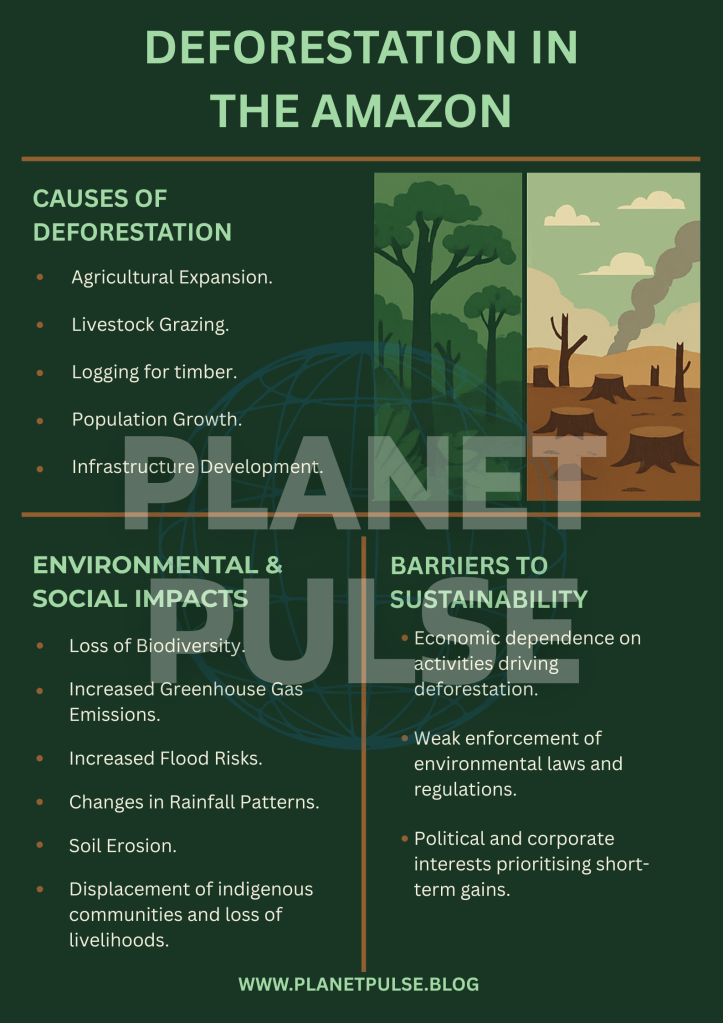
Love this design? Download the high-resolution, printable version here.
What is Sustainable Development
“Sustainable development is development that meets the needs of the present without compromising the ability of future generations to meet their own needs”
Brundtland Report, 1987.
In a world where population growth escalates demands for essential resources, sustainable development becomes paramount. However, as Du Pisani (2006) points out, the term “sustainable development” is often overused and misused, sometimes even contributing to environmental crises resulting from unchecked economic development.
The Significance of Sustainable Development
Sustainable development in Brazil holds great importance due to its status as the largest tropical forest nation. The Amazon region, with its immense biodiversity, provides substantial ecosystem services both regionally and globally (Reyer, 2009). However, despite Brazil’s relatively intact rainforest, deforestation and ecological changes, including fragmentation and forest fires, have emerged as pressing issues (Boucher, Roquemore, & Fitzhugh, 2013).
Deforestation and Climate Change
Deforestation in the Amazon has far-reaching consequences for climate change. Forest fires, increasingly frequent over recent decades, have released significant carbon emissions into the atmosphere, exacerbating climate change and threatening the extinction of numerous species (A World on Fire: The Amazon and Its Effects on the Climate Crisis, 2019).
Economic Interests vs. Environmental Concerns
Brazil’s rapid economic development often prioritizes economic benefits over environmental preservation, leading to exploitation of the Amazon rainforest (Reyer, 2009). While government policies and enforcement actions have made some strides, issues like illegal logging and corruption persist (Boucher, Roquemore, & Fitzhugh, 2013). However, international support, such as Norway’s commitment to compensate Brazil for reducing carbon emissions from deforestation, offers a glimmer of hope.
Challenges in Forest Policies
Brazil’s forest policies have faced criticism for potentially exacerbating deforestation rather than curbing it. Institutional barriers, lack of infrastructure, and corruption have hindered effective forest management (Reyer, 2009). The cheap production of timber has encouraged over-exploitation and illegal logging, undermining conservation efforts.
Impact on Rainfall Patterns
Deforestation in the Amazon also disrupts rainfall patterns. Reduced transpiration from the rainforest contributes to decreased rainfall during the dry season, further compromising the forest’s resilience (Zemp et al., 2017). These changes affect not only local ecosystems but also have global consequences.
Human Activities and Deforestation
Human activities such as farming practices, particularly cattle ranching, have increased deforestation in the Amazon. Forests are cleared to make way for agriculture, resulting in widespread forest fires (A World on Fire: The Amazon and Its Effects on the Climate Crisis, 2019). Policies have managed to address some environmental and economic impacts but have often overlooked social consequences (Barbanti, 2015).
Violence Against Environmentalists
Logging, a contributor to deforestation, has witnessed a rise in violence against environmentalists and land defenders in the Amazon. Indigenous communities advocating for land rights face the most violence, with environmental activists, local farmers, and authorities also targeted by suspected loggers (Lewis, 2019).
The Impact of Tourism
Tourism in Brazil has contributed to economic development and cultural preservation among indigenous communities. However, there are concerns about the negative impacts of tourism, including cultural imperialism, foreign dependency, and environmental damage (Ingles, 2001).
Conclusion
In conclusion, deforestation in the Amazon rainforest poses a significant challenge to sustainable development in Brazil and beyond. This article has explored the concept of sustainable development, emphasized the importance of preserving the Amazon, and examined the effectiveness of Brazil’s forest management laws.
It has also shed light on the role of human activities, including farming, logging, and tourism, in exacerbating deforestation. Achieving sustainable development in the Amazon is a complex task that demands coordinated efforts to balance economic interests with environmental conservation and respect for indigenous communities.
Sources
Barbanti, O. (2015). Economic cycles, deforestation and social impacts in the Brazilian amazon. Agrarian South: Journal of Political Economy, 4(2), 169-196. doi:10.1177/2277976015597121
Boucher, D., Roquemore, S., & Fitzhugh, E. (2013). Brazil’s success in reducing deforestation. Tropical Conservation Science, 6(3), 426-445. doi:10.1177/194008291300600308
Britaldo, S. S., Daniel, C. N., Curran, L. M., Gustavo, C. C., Ricardo, A. G., Claudia, A. R., . . . Schlesinger, P. (2006). Modelling conservation in the amazon basin. Nature, 440(7083), 520. doi:10.1038/nature04389
Brundtland, G. H. (1987). Our common future Oxford U. P.
Du Pisani, J. A. (2006). Sustainable development – historical roots of the concept. Environmental Sciences, 3(2), 83-96. doi:10.1080/15693430600688831
Ingles, P. (2001). Performing traditional dances for modern tourists in the amazon. International Journal of Hospitality & Tourism Administration, 1(3-4), 143-159. doi:10.1300/J149v01n03_09
Lewis, J. T. (2019). Brazil’s criminal logging gangs kill with relative impunity, human rights watch says; gangs have killed dozens of people opposed to their operations in recent years. New York, N.Y: Dow Jones & Company Inc.
Miller, T. (2017). Deforestation, illegal logging, and violence in brazil. Anthropology News, 58(4), e60-e63. doi:10.1111/AN.567
Reyer, C. (2009). Community essay: Sustainable development of the amazon forest: A fine line between conservation and exploitation? Sustainability: Science, Practice, & Policy, 5(2), 38-44.
Seidl, A. F., Silva, Joao Dos Santos Vila de, & Moraes, A. S. (2001). Cattle ranching and deforestation in the Brazilian Pantanal. Ecological Economics, 36(3), 413-425. doi:10.1016/S0921-8009(00)00238-X
Spracklen, D. V., & Garcia‐Carreras, L. (2015). The impact of Amazonian deforestation on amazon basin rainfall. Geophysical Research Letters, 42(21), 9546-9552. doi:10.1002/2015GL066063
West, T. A. P., Vidal, E., & Putz, F. E. (2014). Forest biomass recovery after conventional and reduced-impact logging in Amazonian brazil. Forest Ecology and Management, 314, 59-63. doi: 10.1016/j.foreco.2013.11.022
A world on fire: The amazon and its effects on the climate crisis (2019). Carlsbad: Uloop, Inc.
Zemp, D. C., Schleussner, C. ‐, Barbosa, H. M. J., & Rammig, A. (2017). Deforestation effects on amazon forest resilience. Geophysical Research Letters, 44(12), 6182-6190. doi:10.1002/2017GL072955


 Planet Pulse
Leave a comment