
Far above the tree line, the Arctic’s frozen ground is waking up. But it’s not just thawing soil and shifting landscapes, it’s something invisible, odourless, and immensely powerful: methane. As permafrost melts, it’s releasing massive stores of this potent greenhouse gas into the atmosphere. Methane is capable of turbocharging global warming faster than most climate models predict.
In our first article, we uncovered why permafrost melting is a climate threat few people talk about. Check out the article Here. Now, we dig into its most dangerous secret: the methane bombs hidden beneath the ice.
In this Article
What is Methane and Why It Matters
Methane (CH₄) is a simple gas molecule, but in the climate system, it’s anything but simple. Naturally produced by decomposing organic matter, methane is released from wetlands, livestock, landfills and now, increasingly, from thawing permafrost.
While methane stays in the atmosphere for only about a decade, its short-term heating power is staggering. Over a 20-year period, methane traps about 84–87 times more heat than carbon dioxide. That means even small releases can have significant effects on global temperatures.
How Permafrost Stores Methane
Permafrost locks methane away in two primary forms:
Plants and animals that died thousands of years ago remain preserved in the frozen soil. When permafrost thaws, microbes break down this material, releasing methane and carbon dioxide.
Beneath the frozen layers, under certain conditions, methane forms ice-like crystals called hydrates. When temperatures rise, these crystals destabilize, releasing methane into the atmosphere or water.
The Methane Feedback Loop
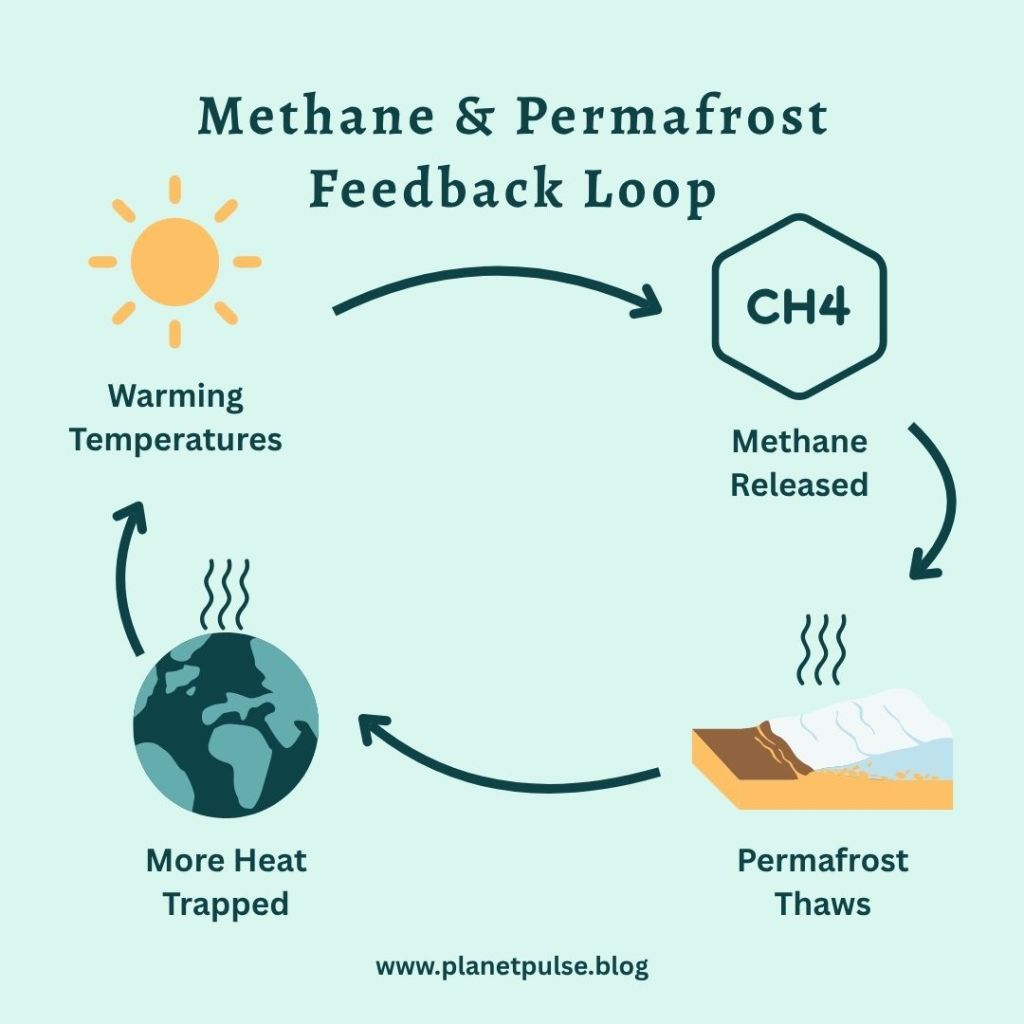
The release of methane from permafrost isn’t just a side effect of warming, it can amplify it. Here’s how the cycle works:
- Warming air temperatures thaw permafrost.
- Thawed permafrost releases methane and CO₂.
- These gases trap more heat in the atmosphere.
- The added heat causes more thawing.
This is what scientists call a positive feedback loop, except “positive” here means “accelerating toward disaster.”
Where Methane is Escaping Now
The release of methane from thawing permafrost isn’t a distant risk. It’s happening now, in visible and sometimes explosive ways across the Arctic. Researchers and local communities have identified several major hotspots where this phenomenon is most striking.
1. Siberia: The Yamal Peninsula’s Exploding Craters
In northern Siberia, the Yamal Peninsula has become infamous for giant, mysterious craters that seem to appear overnight. Scientists believe these “blowout craters” form when methane trapped beneath the permafrost builds up pressure as the ground thaws. Eventually, the gas erupts in an explosive release, ejecting soil and ice and leaving behind massive, gaping holes, some over 50 meters deep.
The region also has numerous thermokarst lakes, where warming permafrost collapses and forms ponds that actively release methane into the air.
2. Alaska’s North Slope: Bubbling Lakes and Thawing Sediments
Across Alaska’s North Slope, winter ice on lakes sometimes hides a strange sight: streams of bubbles rising from below, trapped beneath the frozen surface. These bubbles are methane escaping from thawing lakebeds and surrounding sediments.
Recent field measurements show methane emissions here are higher than earlier climate models predicted, suggesting these lakes could become significant contributors to atmospheric methane as thaw accelerates. Some locals have even demonstrated how the gas can be lit on fire directly through the ice.
3. The Canadian Arctic: Satellite-Detected Methane Hot Spots
In the Canadian Arctic, especially in the Mackenzie River Delta and parts of Nunavut, satellite data has revealed “hot spots” of methane emissions. These are areas releasing far more gas than surrounding landscapes. These hotspots are often linked to collapsing peatlands and thawing permafrost along coastlines.
Researchers are increasingly using remote sensing to monitor these areas year-round, as their remote locations make ground surveys challenging. The data show methane is escaping even in winter, when frozen ground was once thought to be impermeable.
Across these regions, the signs are both visible and measurable. Locals report changes in the land, such as lakes forming where none existed, ground subsiding, and in some cases, strange new smells in the air. For scientists, these hotspots are natural laboratories, revealing how quickly the Arctic is transforming and how urgently the world must prepare for the consequences.
The Global Stakes
The Arctic permafrost region contains an estimated 1,400 gigatons of carbon. Much of it in forms that could become methane or CO₂ if thawed. Even a fraction of this released quickly could significantly disrupt climate stability.
Here’s why it matters for everyone:
- Accelerated warming can trigger more extreme weather worldwide.
- Shifts in polar conditions can disrupt ocean currents and weather patterns far from the Arctic.
- The release is hard to reverse as once methane is in the atmosphere, we can’t recapture it at scale.
Frequently Asked Questions (FAQs)
Why is methane more dangerous than CO₂ for climate change?
Methane traps far more heat in the short term, meaning it can cause rapid temperature increases before breaking down into CO₂.
Is methane from permafrost already affecting our climate?
Yes. Both field measurements and satellite observations confirm significant methane emissions from Arctic permafrost regions.
Can we stop methane release from permafrost?
Preventing permafrost thaw directly is nearly impossible. The best approach is to slow global warming overall, which delays further thaw.
Conclusion
Methane from thawing permafrost is a significant climate issue, one that scientists warn could push the planet toward dangerous tipping points sooner than expected. It’s a problem unfolding quietly in some of the most remote corners of Earth, yet its effects could ripple across every continent.
Curious to learn more about what’s really happening beneath the ice? Check out the rest of our deep-dive articles on permafrost.
- Melting Permafrost: The Climate Threat Nobody’s Talking About
- Sinking Cities: The Permafrost Crisis Explained
- Ancient Viruses: The Risks of Melting Permafrost



 Planet Pulse
Leave a comment