
One of the most frequent and damaging natural disasters on Earth is flooding. Rising seas cause damage to houses, interfere with livelihoods and alter landscapes for millions of people each year. Flood risks are rising in both urban and rural areas as sea levels continues to rise and rainfall patterns become more intense due to climate change. This article explores what floods are, the different types of floods, their causes and the methods that communities might use to prevent and mitigate those effects.
In this Article
What Are Floods?
Flooding happens when water spills into a generally dry terrain. Depending on the type of flood and the circumstances that cause it, this might occur gradually over several days or quickly in a matter of minutes.
The way watersheds, or the land areas that drain rainwater into rivers, lakes, and seas, behave shapes floods. Flooding occurs when rainfall surpasses the land’s capacity to absorb or direct water.
Key hydrological concepts that help explain flood behaviour include:
- Runoff: Water flowing over land surfaces.
- Infiltration: Water soaking into the ground.
- Floodplain: Low‑lying land adjacent to rivers that naturally accommodate excess water during high flows.
- Return period: The statistical likelihood of a flood event e.g., a “1‑in‑100‑year flood”.
- Hydrograph: A graph showing how river levels rise and fall during storms
Floods can be natural, driven by weather and seasonal patterns or human‑induced, resulting from land‑use changes, poor drainage, or climate‑related shifts.
Types of Floods
Flooding is a multifaceted occurrence that varies according on land use, climate, and geography. Communities can better prepare if they are aware of these kinds.
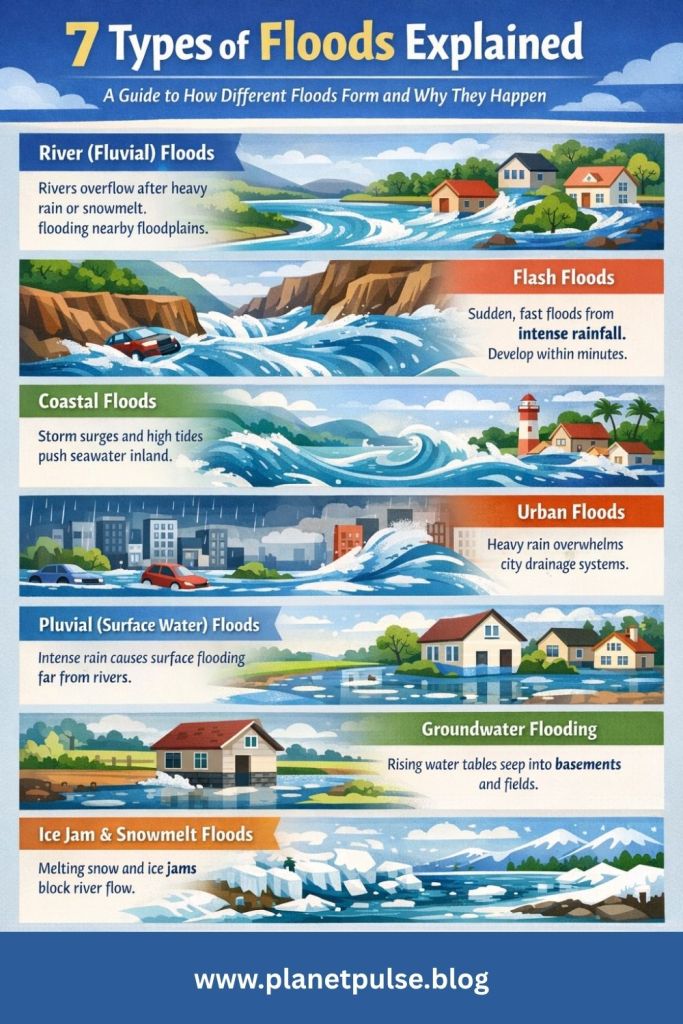
- River (Fluvial) Floods: These occur when rivers overflow their banks due to prolonged rainfall, snowmelt or upstream land‑use changes. They often affect large areas and can last for days or weeks.
- Flash Floods: Flash floods develop rapidly, often within minutes following intense rainfall or sudden dam failures. They are especially dangerous in steep valleys, dry riverbeds and urban areas.
- Coastal Floods: Driven by storm surges, high tides and sea‑level rise, coastal floods threaten low‑lying coastal communities. Tropical cyclones and winter storms can push seawater far inland.
- Urban Floods: Cities are highly vulnerable due to impermeable surfaces like concrete and asphalt. When drainage systems are overwhelmed, even moderate rainfall can cause severe surface flooding.
- Pluvial (Surface Water) Floods: Occur when rainfall is too intense for the ground to absorb. They can happen anywhere, even far from rivers and are becoming increasingly common in the UK.
- Groundwater Flooding: After long periods of rainfall, water tables rise and seep into basements, roads and fields. This type of flooding is slow to appear and slow to recede.
- Ice Jam & Snowmelt Floods: In colder regions, melting snow or ice blockages in rivers can cause sudden rises in water levels.
Causes of Flooding
Floods arise from a combination of natural processes and human activities, often interacting in complex ways.
Natural Causes
Heavy or prolonged rainfall is the most common natural trigger of flooding. This is because when rainfall intensity exceeds the land’s ability to absorb water, surface runoff increases and rivers swell, leading to flooding.
Snowmelt can also release large amount of water in a short period, especially during sudden warm spells. Also, in colder regions, ice jams can block river channels, forcing water to spill onto surrounding land which increases the likelihood of flooding in an area.
Apart from this, coastal areas face additional risks from storm surges, where strong winds and low pressure push seawater inland. Seasonal weather systems such as monsoons and tropical cyclones bring sustained rainfall that saturates soils and rivers. Even natural changes in river channels, such as erosion or sediment build‑up, can reduce a river’s capacity and increase flood risk
Human Causes
Human activities often amplify natural flood risks. Urbanisation replaces permeable soils with concrete and asphalt, reducing infiltration and increasing runoff.
Deforestation removes vegetation that would normally absorb rainfall and stabilise soils. Poorly designed or poorly maintained drainage systems can quickly become overwhelmed during storms.
Moreover, river engineering projects such as dams, levees and channel straightening can disrupt natural flow patterns, sometimes increasing flood risk downstream. Also, climate change intensifies many of these pressures by increasing rainfall intensity and raising sea levels, making floods more frequent and more severe.
Impacts of Floods
Flooding has effects that go much beyond the immediate presence of water. Floods have the potential to destroy habitats, erode soils and deposit sediment in rivers. Water bodies can become contaminated by pollutants, sewage, and agricultural runoff, endangering both human health and ecosystems.
Social effects are just as important. Floods have the power to destroy houses, uproot entire towns and interfere with vital services like transportation, healthcare and energy. Apart from this, damp conditions encourages the growth of mould inside buildings, while contaminated water supplies raise the danger of waterborne illnesses.
Floods have the potential to cost billions of pounds. Roads, bridges and utilities are examples of infrastructure that might need major repairs. There can be significant agricultural losses, especially when fields are submerged for extended periods of time. Businesses may have to close for extended periods of time and it may take months or even years to recover.
Flood Prevention and Mitigation
Effective flood management requires a combination of engineering solutions, nature‑based approaches and community‑level planning.
This is due to the fact that engineered structures like reservoirs and dams assist control river flow by storing extra water. Communities are shielded from rising water levels by physical barriers like levees and floodwalls. Green roofs, permeable pavements, swales and retention ponds are examples of sustainable drainage systems (SuDS) that assist delay and absorb runoff in urban settings. To protect themselves from storm surges and high tides, coastal communities rely on sea walls, breakwaters, and tidal barriers.
Nature provides effective means of lowering the risk of flooding. Natural storage spaces that absorb floodwater are created when wetlands are restored. Reforestation lowers runoff by stabilising soils and increasing infiltration. Reconnecting rivers to their floodplains lowers pressure downstream by allowing water to safely disperse during high floods. Permeable materials and vegetated surfaces are examples of green infrastructure in cities that assist replicate natural hydrological processes.
In order to manage the risk of flooding, policy frameworks are essential. Communities have time to prepare or escape thanks to early warning systems. By preventing development in high-risk locations, land-use planning can lessen long-term vulnerability. Response capability is strengthened by emergency preparedness, which includes local resilience groups, evacuation plans, and community drills. Insurance programs promote recovery following flood occurrences and offer financial protection.
Climate Change and the Future of Flooding
Globally, flood patterns are changing due to climate change. Rainfall is heavier and more intense when the air is warmer because it retains more moisture. Coastal flooding is more likely as sea levels rise, particularly during storms. In the UK, winter storms are becoming more severe and surface water flooding is becoming more frequent. These shifts underscore the necessity of adaptation measures that include community readiness, nature-based solutions, and resilient infrastructure.
How Individuals and Communities Can Prepare
Being ready for floods starts at home. Families can create flood plans that include safe locations to keep vital papers, emergency contacts, and evacuation routes. Families can react swiftly to an emergency by assembling an emergency kit with necessities like water, medicine and candles.
Sandbags, raised appliances and temporary barriers are examples of property-level protection measures that might lessen damage. When it rains a lot, installing non-return valves helps keep sewage from backing up into houses.
Resilience within the community is equally crucial. Collective response is strengthened by coordinated emergency planning, pooled communication networks and local flood groups. Understanding local flood risk maps enables locals to make well-informed choices about insurance, property upgrades and readiness.
Conclusion
Floods are strong natural occurrences influenced by geography, climate and human activity. Building resilient communities requires an awareness of flood types, causes and prevention techniques as risks rise globally.


 Planet Pulse
Leave a comment