
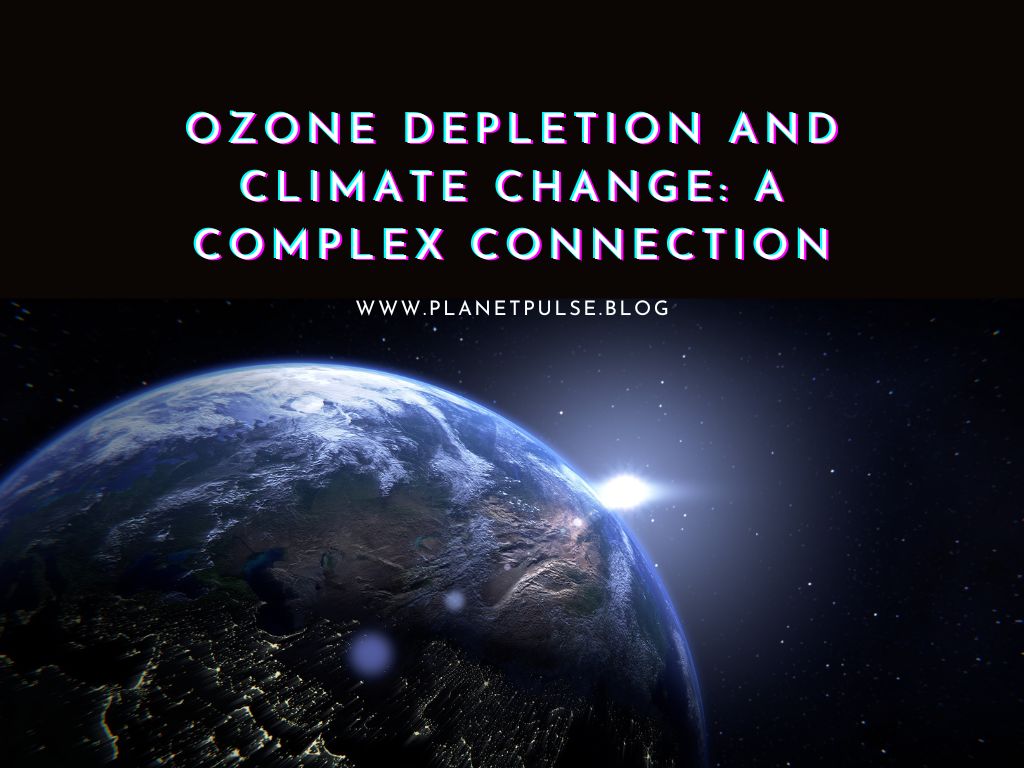
For decades, the world has faced two of the most pressing environmental challenges: ozone depletion and climate change. While these crises are often discussed separately as one is framed around the “ozone hole” and harmful ultraviolet (UV) radiation, and the other around rising global temperatures and extreme weather. Yet, they are deeply interconnected in the atmosphere.
Both are shaped by human emissions, international policies, and complex feedback loops in Earth’s climate system. Understanding how they overlap is key to making progress on both. This article explores how greenhouse gases influence stratospheric temperatures, how ozone recovery is progressing in a warming world, and why climate and ozone policies must work hand in hand.
In this Article
The Science of Ozone Depletion
The ozone layer, located in the stratosphere about 15–35 kilometers above Earth’s surface, acts as a protective shield. It absorbs most of the Sun’s harmful UV-B radiation, protecting human health, ecosystems, and agricultural productivity.
In the late 20th century, scientists discovered severe seasonal thinning of this layer, particularly over Antarctica. The culprit was a class of synthetic chemicals called ozone-depleting substances (ODS), including chlorofluorocarbons (CFCs) used in refrigeration, air conditioning, and aerosol sprays.
When released into the atmosphere, ODS rise to the stratosphere, where sunlight breaks them down, releasing chlorine and bromine atoms. These atoms act as catalysts, destroying ozone molecules far faster than natural processes.
The global response was swift: the Montreal Protocol on Substances that Deplete the Ozone Layer (1987) successfully phased out the production and use of many ODS. This treaty is considered one of the most effective international environmental agreements ever implemented.
But the story didn’t end there because ozone depletion is deeply intertwined with climate change.
Greenhouse Gases and Stratospheric Temperatures
The greenhouse effect is well known: gases such as carbon dioxide (CO₂), methane (CH₄), and nitrous oxide (N₂O) trap heat in the lower atmosphere (the troposphere), driving global warming. But fewer people realise that this process also cools the stratosphere above.
Here’s why:
- In the troposphere, greenhouse gases absorb heat radiated from Earth’s surface, warming the lower atmosphere.
- Less heat escapes upward, so the stratosphere receives less energy and therefore cools.
This stratospheric cooling has direct consequences for the ozone layer. In polar regions, colder stratospheric conditions encourage the formation of polar stratospheric clouds (PSCs). These clouds provide surfaces for chemical reactions that release active chlorine and bromine, which accelerate ozone destruction.
In other words, greenhouse gases indirectly worsen ozone depletion in some contexts by making the stratosphere colder.
At the same time, this cooling effect can also help ozone recovery in non-polar regions by slowing down certain reactions that break down ozone. The relationship is complex: greenhouse gases are simultaneously warming the surface, cooling the stratosphere, and reshaping global atmospheric circulation patterns.
Ozone Recovery in a Changing Climate
Thanks to the Montreal Protocol, the use of most ozone-depleting substances has dropped dramatically. Evidence shows that the ozone layer is on track to recover to 1980 levels by the middle of the 21st century. But this recovery is unfolding in the context of climate change, which complicates the picture.
The Antarctic Ozone Hole
The Antarctic ozone hole still appears each spring (September–November). Stratospheric cooling caused by greenhouse gases prolongs the conditions that allow PSCs to form, slowing recovery in this region. Scientists project that the Antarctic ozone layer may not fully recover until the 2060s.
The Role of Nitrous Oxide
While CFCs and other banned ODS are declining, nitrous oxide (N₂O), which is a potent greenhouse gas from agriculture and industry, remains both a contributor to climate change and a threat to ozone. Unlike CFCs, N₂O is not yet regulated under the Montreal Protocol, making it a key challenge moving forward.
The Kigali Amendment and HFCs
One unintended consequence of the Montreal Protocol was the widespread adoption of hydrofluorocarbons (HFCs) as substitutes for CFCs. While HFCs do not deplete ozone, they are powerful greenhouse gases. The Kigali Amendment (2016) added HFCs to the list of substances being phased down, recognising the need to align ozone recovery with climate mitigation.
Thus, the line between ozone protection and climate policy has blurred.
Climate Change and Ozone: Overlapping Solutions
The good news is that actions to protect the ozone layer often have climate co-benefits, and vice versa.
How Climate Policies Reinforce Ozone Recovery
- Phasing out HFCs under the Kigali Amendment reduces warming potential while preventing harmful substitutes from undermining ozone recovery.
- Reducing CO₂ emissions through renewable energy, energy efficiency, and electrification helps stabilize stratospheric temperatures, creating more favourable conditions for ozone.
How Ozone Policies Support Climate Goals
The Montreal Protocol has already prevented millions of cases of skin cancer and cataracts. But it has also delivered one of the largest climate benefits of any environmental treaty. By eliminating CFCs, the protocol prevented an estimated equivalent of 135 billion tons of CO₂ emissions between 1990 and 2010. Without it, global warming would be significantly worse today.
The Importance of Integrated Action
The Paris Agreement (2015) and the Montreal Protocol now operate as twin pillars of atmospheric protection. While one focuses on greenhouse gas emissions and the other on ozone-depleting substances, both contribute to safeguarding climate stability. Future progress requires coordinating these policies rather than treating them in isolation.
Why This Matters for the Future
Understanding the ozone-climate connection is not just about atmospheric chemistry, it’s about the impacts on human society and ecosystems.
1. Human Health
- UV protection: Without a strong ozone layer, humans face higher risks of skin cancer, cataracts, and immune system suppression.
- Heat and air quality: Climate change worsens air pollution and heat stress, which combined with UV exposure, create compounded health risks.
2. Ecosystems and Agriculture
- Phytoplankton, the foundation of marine food webs, are sensitive to UV radiation. Protecting the ozone layer safeguards ocean ecosystems.
- Crops such as soybeans and wheat also benefit from reduced UV stress, supporting global food security.
Feedback Loops
- Stratospheric circulation changes influence regional weather patterns, potentially altering rainfall and wind systems.
- Ozone recovery itself affects climate, since ozone is also a greenhouse gas. As the ozone layer heals, it will interact with climate dynamics in ways scientists are still studying.
In short, ozone protection and climate mitigation are inseparable. The success of one strengthens the other.
Frequently Asked Questions (FAQs)
How do greenhouse gases affect the ozone layer?
Greenhouse gases warm the troposphere but cool the stratosphere. This cooling changes ozone chemistry, sometimes helping recovery in mid-latitudes but worsening ozone loss in polar regions.
Is the ozone hole the same as climate change?
No. The ozone hole is caused by chemical reactions involving ODS, while climate change is caused by greenhouse gases like CO₂ and CH₄. They are different problems but interconnected.
Has the ozone layer fully recovered?
Not yet. While significant progress has been made, full recovery is expected by mid-to-late 21st century, depending on the region and emissions trends.
How do climate agreements like the Paris Agreement affect ozone recovery?
Indirectly. By reducing greenhouse gas emissions and phasing out HFCs, climate agreements create conditions that also support ozone recovery.
What can individuals do to help both ozone and climate?
• Use energy efficiently and switch to renewable power where possible.
• Support policies that reduce greenhouse gas emissions.
• Avoid products with harmful refrigerants or ensure safe disposal.
• Stay informed and advocate for strong international cooperation.
Conclusion
The history of the ozone crisis shows that global cooperation can succeed. The Montreal Protocol is proof that science-based international agreements can reverse environmental damage. The challenge now is to apply the same level of commitment to climate change, while recognizing that ozone recovery and climate mitigation are two sides of the same coin.
By reducing emissions, phasing out harmful chemicals, and pursuing integrated solutions, humanity can protect both the ozone layer and the climate system. These efforts are not separate battles, but part of the same fight for a sustainable future.




 Planet Pulse
Leave a comment