
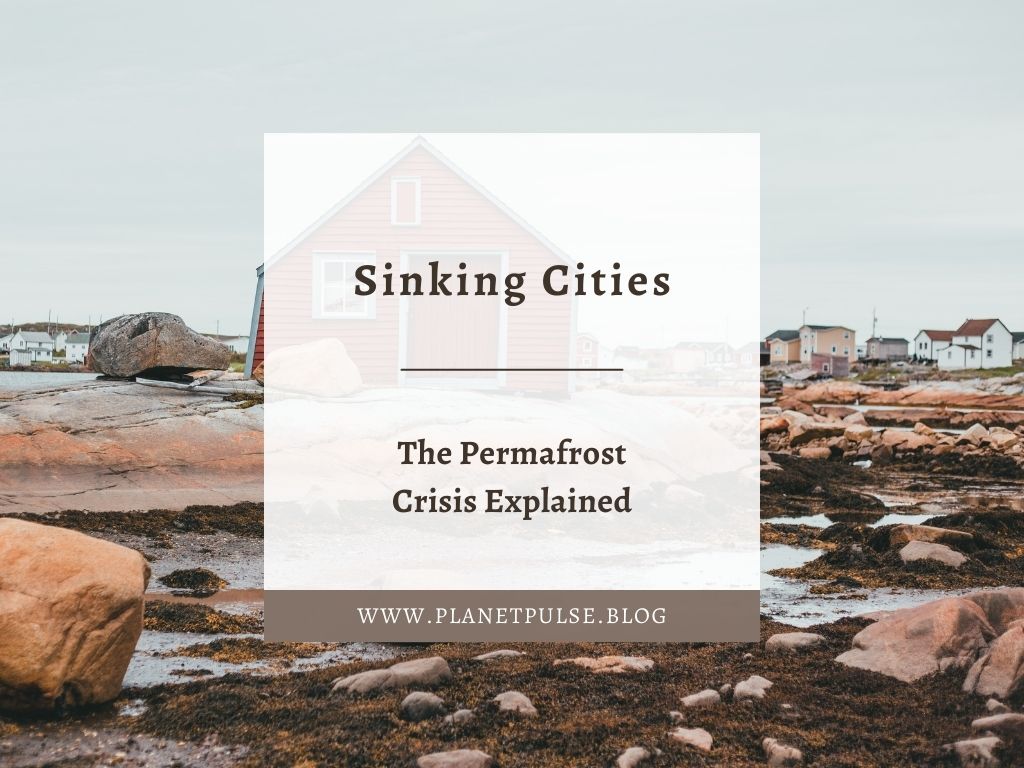
When your home’s foundation starts shifting, you call a contractor. But what happens when the ground itself is melting away?
Across the Arctic and other permafrost regions, roads are buckling, buildings are tilting, and entire villages are sinking. The culprit isn’t an earthquake or poor construction, but the slow, relentless thaw of once-frozen ground.
Permafrost, long considered nature’s most stable foundation, is now destabilising at an alarming rate. The result is an unfolding infrastructure crisis that’s already costing billions and forcing some communities to face an unthinkable choice: adapt, relocate, or disappear.
In this Article
Permafrost: The Arctic’s Frozen Foundation
Beneath the Arctic’s tundra and boreal forests lies a hidden layer that has quietly supported life and infrastructure for millennia: permafrost. This frozen ground, composed of soil, rock, and ice, can extend hundreds of meters deep and has remained solid for thousands of years.
For engineers and builders in northern regions, permafrost was once considered a reliable foundation. Homes, pipelines, roads, and even entire cities were designed with the assumption that the ground beneath would remain permanently frozen.
But that’s no longer the case. The Arctic is warming nearly four times faster than the global average. As a result, permafrost is thawing rapidly. However, not all permafrost is the same. Its extent and stability vary with climate and geography. Scientists often distinguish between continuous permafrost and discontinuous permafrost.
Continuous Permafrost
- Found in the coldest Arctic and subarctic regions.
- The ground remains frozen almost everywhere and year-round, sometimes hundreds of meters deep.
- Thaw happens slowly in most places because the frozen layer is thick and uninterrupted.
Discontinuous Permafrost
- Found in slightly warmer areas closer to the southern edge of the permafrost zone.
- Consists of a patchwork: some ground remains frozen year-round, while nearby spots thaw in summer.
- These warmer conditions make the frozen patches far more vulnerable to rapid melt.
The loss of this frozen base isn’t gradual in all cases. In many places, thaw is sudden and dramatic. A collapse that can bring down entire structures, disrupt transportation, and sever vital utilities.
How Thawing Destroys Infrastructure
When permafrost thaws, it’s not just the ice that disappears, but the structural integrity of the ground itself. Ice locked within soil and rock acts like cement, binding everything together. Once that ice melts, the soil can settle unevenly, tilt, or collapse entirely.
Key Processes Behind the Damage
- Ground Subsidence: The land surface drops as ice melts and voids form beneath.
- Thermokarst Formation: Thawing ice-rich permafrost creates uneven terrain, depressions, and sinkhole-like features.
- Frost Heave vs. Thaw Settlement: In winter, ice expansion can push structures upward (frost heave), but as ice melts in summer, the same ground can sink permanently (thaw settlement).
Real-World Examples
- Dalton Highway, Alaska: One of the Arctic’s most vital transport routes needs constant repair as thaw causes dangerous warping and potholes.
- Norilsk, Russia: Over 60% of buildings have sustained damage, with some abandoned as foundations fail.
- Inuvik, Canada: Airport runways buckle and require resurfacing as the ground shifts beneath them.
These failures aren’t isolated, they ripple outward, disrupting supply chains, isolating communities, and raising the cost of living in regions already challenged by remoteness.
Communities on the Brink
The collapse of Arctic infrastructure isn’t just a matter of cracked roads or uneven floors, it’s a direct threat to the survival of entire towns. In some cases, repairing damage costs more than the community can afford. In others, the land is becoming so unstable that relocation is the only viable option.
Places Facing the Greatest Risks
- Shishmaref, Alaska: A coastal village where thawing permafrost and coastal erosion work hand-in-hand to eat away land. Relocating the entire community is estimated to cost $180 million.
- Norilsk, Russia: Once considered a fortress of Soviet engineering, it now has apartment blocks leaning visibly, with residents evacuated for safety.
- Tuktoyaktuk, Canada: The thawing ground has shifted homes and is undermining coastal roads, while storm surges threaten to wash away parts of the town entirely.
For Indigenous communities, the damage goes far deeper than physical structures. It means loss of ancestral homes, disruption of traditional hunting and fishing routes, and the disappearance of cultural ties built over centuries.
As permafrost thaw accelerates, some residents are forced into impossible decisions: invest in expensive temporary repairs, abandon their homes, or leave behind the land that defines their identity.
The Economic Toll
Repairing infrastructure in permafrost zones is expensive and in some cases, temporary.
- Projected Costs: By 2050, damages to Arctic infrastructure could exceed $100 billion across Russia, Canada, Alaska, and Greenland combined.
- Relocation Costs: Moving entire communities, as seen in Shishmaref or Newtok (Alaska), can range from $100–200 million per village.
- Maintenance Spiral: As thaw accelerates, maintenance becomes constant, diverting funds from other essential services.
Why Costs Escalate So Quickly
- Remote Access: Heavy equipment, materials, and skilled labour often must be flown in or shipped during a short summer season.
- Temporary Fixes: Many repairs are stopgaps, which are patches that fail again within a few years as thaw progresses.
- Cascading Failures: When roads collapse, supply chains break down, raising the cost of every other service and repair.
For some Arctic towns, the economic math is bleak: invest endlessly in maintenance or face the equally steep cost of relocation. Either way, the bill is coming due much sooner than expected.
Engineering Solutions and Adaptations
Some regions are experimenting with new construction techniques to combat thaw damage, such as:
| Adaptation Method | How It Works | Pros | Cons |
|---|---|---|---|
| Elevated Buildings on Stilts | Allows air circulation to keep ground frozen | Effective for small structures | Expensive & not suited for heavy loads |
| Thermosyphons | Pipes that remove heat from the ground | Proven in pipelines and roads | High installation & maintenance cost |
| Adjustable Foundations | Can be levelled over time as ground shifts | Extends building lifespan | Labour-intensive & limited in scope |
| Insulated Roadbeds | Reduces heat transfer from roads into permafrost | Delays thaw | Costly & not feasible everywhere |
While these solutions help, they can only slow down the thawing process, but not completely stop the inevitable thaw in high-risk zones.
Frequently Asked Questions (FAQs)
Can damaged buildings in permafrost zones be repaired?
Sometimes, but repairs are often temporary unless the ground is stabilised or the structure is moved.
How quickly can permafrost thaw cause damage?
In some places, major structural problems have appeared in less than a decade.
Are areas outside the Arctic affected?
Yes. High mountain regions in Tibet, the Andes, and the Alps are also seeing thaw-related instability.
Conclusion
Permafrost thaw is not only an environmental issue, it is also a human and economic crisis unfolding in real time. Communities face collapsing infrastructure, governments face rising costs, and industries face disrupted operations, all while the planet warms. Addressing this challenge demands urgency, substantial funding, and bold engineering innovation to adapt our roads, buildings, and pipelines to a changing Arctic landscape.
Curious to learn more about what’s really happening beneath the ice? Check out the rest of our deep-dive articles on permafrost.
- Melting Permafrost: The Climate Threat Nobody’s Talking About
- Methane Bombs Beneath the Ice: How Permafrost Fuels Global Warming – Planet Pulse
- Ancient Viruses: The Risks of Melting Permafrost




 Planet Pulse
Leave a comment