
One of the most powerful climate phenomena influencing global weather patterns is La Niña. La Niña is the opposite of El Niño, which heats the Pacific Ocean, and is the cool phase of the El Niño–Southern Oscillation (ENSO) cycle.
La Niña can be just as disruptive, affecting hurricanes, agriculture, and global food security, while El Niño frequently makes headlines for its catastrophic droughts and floods. Understanding La Niña is essential for governments, corporations, and communities in order to prepare for climate hazards.
In this Article
What Is La Niña?
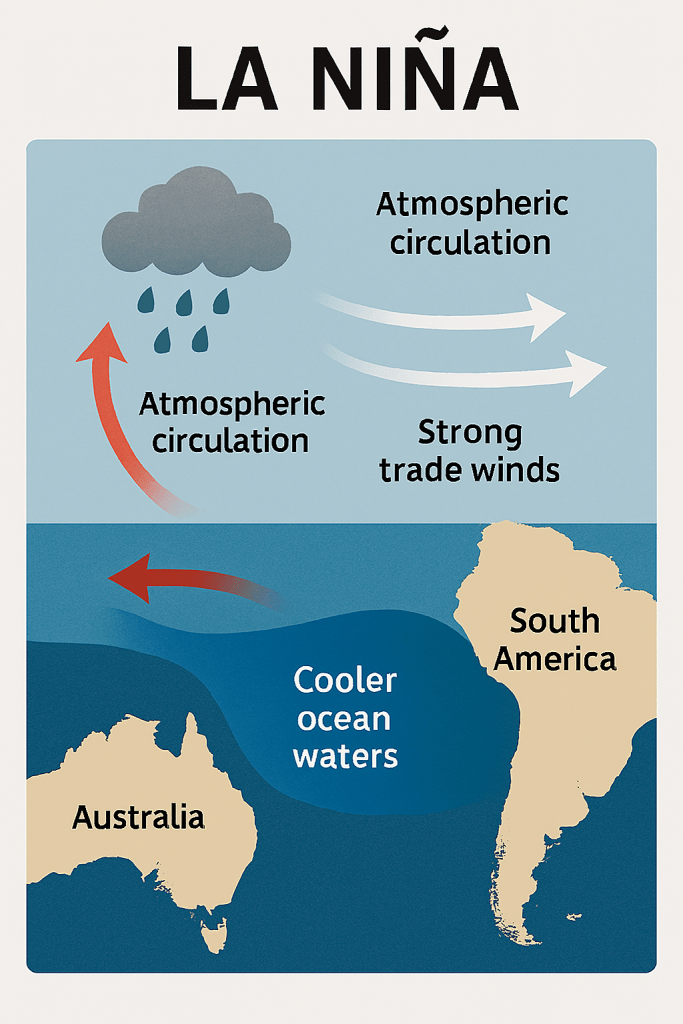
La Niña happens when sea surface temperatures in the central and eastern tropical Pacific Ocean are below average. This cooling increases trade winds and changes atmospheric circulation, causing rippling effects across continents.
- Frequency: La Niña normally occurs every 2-7 years.
- Duration: Most events endure 9-12 months, but some last for several years.
- The ENSO Cycle: consists of three phases: El Niño (warm), Neutral, and La Niña (cold).
Causes of La Niña
La Niña is caused by interrelated oceanic and atmospheric processes, such as:
- Stronger Trade Winds: Drive warm water westward towards Asia.
- Cold Water Upwelling: Nutrient-rich cold water rises to the surface off the coast of South America.
- Walker Circulation Intensification: The east-west atmospheric circulation increases, resulting in increased cooling.
These mechanisms form a feedback loop that perpetuates La Niña conditions.
Global Impacts of La Niña
La Niña has significant worldwide implications. For example:
North America
Colder winters in northern U.S. and Canada.
Wetter conditions in the Pacific Northwest.
Drier weather in the southern U.S. (Texas, California).
South America
Flooding in northern Brazil.
Drought in Argentina and Peru, impacting soybean and corn yields.
Asia-Pacific
Stronger monsoons in Southeast Asia.
Increased cyclone activity in Australia.
Africa
Drought in East Africa, worsening food insecurity.
Wetter conditions in southern Africa, boosting crops but raising flood risks
Economic and Environmental Impacts
- Natural Disasters: Floods, droughts, hurricanes.
- Agriculture: Crop yield volatility, food insecurity.
- Fisheries: Boosted productivity from nutrient-rich waters.
| Feature | El Niño (Warm Phase) | La Niña (Cool Phase) |
|---|---|---|
| Sea Surface Temperature | Warmer than average | Cooler than average |
| Trade Winds | Weakened | Strengthened |
| Rainfall in Americas | Increased in western South America | Decreased in western South America |
| Asia-Pacific Weather | Drier conditions | Wetter conditions |
| Cyclone Activity | Reduced in Australia | Increased in Australia |
Historical Examples of La Niña Events
The Australian Bureau of Meteorology’s La Niña Case Studies has found historical examples of La Nina episodes, such as:
- 1988–1989: One of the strongest La Niña episodes, with ocean temperatures dropping 7°F below normal.
- 2010–2011: Severe floods in Queensland, Australia, causing billions in damages.
- 2020–2022: Multi-year La Niña causing drought in East Africa and floods in South Asia, worsening humanitarian crises.
These events highlight La Niña’s ability to disrupt economies and ecosystems.
Monitoring and Prediction
Agencies like NOAA and the World Meteorological Organization (WMO) monitor La Niña using:
- Satellite data for sea surface temperatures.
- Ocean buoys measuring currents and upwelling.
- Predictive models for seasonal forecasts.
Accurate forecasting helps governments prepare for agricultural impacts, disaster response, and water management.
Frequently Asked Questions (FAQs)
How long does a La Niña event usually last?
La Niña events typically last 9–12 months, though some can persist for up to two years.
How is La Niña different from El Niño?
La Niña is the cooling phase of the ENSO cycle, while El Niño represents the warming phase.
Can La Niña and El Niño occur back-to-back?
Yes. ENSO phases often alternate, although neutral conditions may occur between events.
How does La Niña affect hurricanes?
La Niña tends to increase Atlantic hurricane activity due to reduced vertical wind shear.
Is La Niña influenced by climate change?
Research suggests climate change may intensify ENSO impacts, but the relationship remains complex and under active study.
Conclusion
La Niña is a significant climate driver that impacts weather, crops, and economics. Monitoring ENSO cycles allows scientists and politicians to better plan for floods, droughts, and storms. Understanding La Niña goes beyond science to promote resilience, sustainability, and community safety globally.



 Planet Pulse
Leave a comment