
El Niño is a powerful climate phenomenon that can alter weather patterns, destroy ecosystems, and affect global economy. Though it originates in the Pacific Ocean, its rippling effects can be felt all over the world, from droughts in Australia to floods in South America. This article explains what El Niño is, why it occurs, how it affects the world, and answers common questions to help you understand its significance.
In this Article
What Is El Niño?
El Niño is the warm phase of the El Niño–Southern Oscillation (ENSO), a climate phenomenon that affects ocean temperatures and atmospheric conditions in the tropical Pacific. Peruvian fishermen noticed unusually warm waters around Christmas and coined the term “El Niño,” which translates to “the little boy” in Spanish. Scientists today, recognise El Niño as a significant cause for disruption for global climate systems.
Causes of El Niño
To understand the physics of El Niño, we must examine ocean-atmosphere interactions in the equatorial Pacific.
1. Weakening of Trade Winds
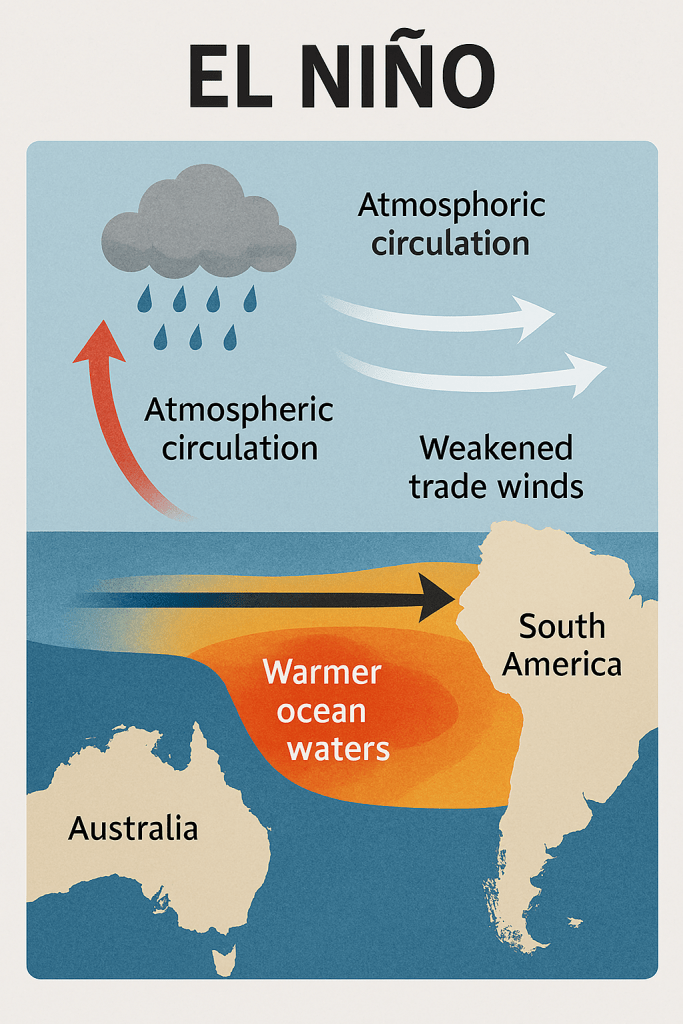
Under normal conditions, strong trade winds blow westward across the Pacific, pushing warm surface waters toward Asia and allowing cold water to rise near South America. During El Niño, these trade winds weaken or even reverse, causing warm water to accumulate in the central and eastern Pacific.
2. Warming of Pacific Ocean Waters
As the trade winds weaken, warm water that normally gathers around Indonesia moves eastward. This shift changes the temperature gradient throughout the Pacific, affecting the Walker Circulation, a mechanism of rising and sinking air that drives tropical weather patterns.
3. Atmospheric Pressure Changes
El Niño affects atmospheric pressure, as measured by the Southern Oscillation Index (SOI). El Niño occurs when pressure drops over the eastern Pacific and rises over the western Pacific, leading to changed wind and ocean current patterns.
The diagram below illustrates how weakened trade winds allow warm ocean water to accumulate near South America, altering atmospheric circulation and triggering extreme weather patterns worldwide.
Effects of El Niño
El Niño’s impacts are vast and varied, affecting weather, ecosystems, and human livelihoods across the globe. Some of the effects include:
1. Weather Disruptions
- Droughts in Australia: The shift in warm water reduces rainfall in regions that typically rely on monsoons, leading to severe droughts and water shortages.
- Floods in South America: Warmer waters near the coast increase evaporation and precipitation, causing intense rainfall and flooding in countries like Peru and Ecuador.
- Altered Hurricane Activity: El Niño can suppress Atlantic hurricanes while enhancing cyclone activity in the Pacific, changing disaster preparedness strategies.
2. Ecosystem Stress
- Marine Life Decline: Warmer waters reduce nutrient upwelling, leading to lower fish populations and affecting food chains from plankton to predators.
- Coral Bleaching: Elevated sea temperatures stress coral reefs, causing widespread bleaching and loss of biodiversity.
- Disrupted Migration Patterns: Birds, fish, and marine mammals may alter their routes or breeding cycles due to changes in ocean conditions.
3. Human and Economic Impacts
- Agricultural Losses: Crop failures due to droughts or floods can lead to food insecurity and rising prices.
- Health Risks: Increased rainfall may boost mosquito populations, raising the risk of diseases like malaria and dengue.
- Economic Strain: Fishing, farming, and tourism industries often suffer during El Niño events, especially in developing nations.
Global Reach of El Niño
Though centred in the Pacific, El Niño’s effects extend to every continent:
| Region | Impact |
|---|---|
| South America | Heavy rainfall, flooding, landslides |
| Australia | Droughts, wildfires, crop failure |
| Southeast Asia | Reduced monsoons, water scarcity |
| North America | Warmer winters, increased rainfall in south |
| Africa | Droughts in southern regions, floods in east |
| Europe | Milder winters, variable storm activity |
How Often Does El Niño Occur?
El Niño occurs every 2–7 years and can last 9–12 months. Some episodes last for longer periods of time, depending on oceanic and atmospheric circumstances. Scientists track sea surface temperatures and wind patterns to predict its approach.
Is El Niño Related to Climate Change?
El Niño is a natural phenomena, although climate change may impact its frequency and intensity. Warmer global temperatures may exacerbate the effects of El Niño, leading to drier conditions and stronger storms. However, research is ongoing to better understand the relationship between ENSO and long-term climate changes.
How Is El Niño Predicted?
Meteorologists use satellite data, ocean buoys, and climate models to predict El Niño. Key indicators are:
- Rising sea surface temperatures in the middle and eastern Pacific.
- Changes in trade wind strength.
- Variations in air pressure (Southern Oscillation Index).
Governments and communities can use early warning systems to prepare for anticipated repercussions.
El Niño vs. La Niña
El Niño and La Niña are opposite phases of the El Niño–Southern Oscillation (ENSO).
While El Niño warms the Pacific Ocean and disrupts rainfall, La Niña cools the Pacific and often brings reverse effects.
| Feature | El Niño | La Niña |
|---|---|---|
| Ocean Temperature | Warmer in eastern Pacific | Cooler in eastern Pacific |
| Trade Winds | Weakened or reversed | Strengthened |
| Rainfall | Increased in America | Increased in Asia/Australia |
| Global Impact | Warmer global temperatures | Cooler global temperatures |
Want to learn more? Read our full guide to La Niña for a deeper dive into its causes and impacts. (Link to be added).
Frequently Asked Questions (FAQs)
How often does El Niño occur?
El Niño occurs every 2–7 years, depending on ocean–atmosphere conditions.
How long does El Niño last?
It typically lasts 9–12 months, though some events can extend beyond a year.
Is El Niño linked to climate change?
Not directly, but climate change may intensify El Niño’s impacts.
How is El Niño predicted?
Scientists use satellite monitoring, ocean buoys, and advanced climate models.
What’s the difference between El Niño and La Niña?
El Niño warms the Pacific and disrupts rainfall patterns, while La Niña cools the Pacific and often brings opposite climate effects.
Conclusion
El Niño highlights how interwoven our planet’s systems are. From shifting winds over the Pacific to floods in South America and droughts in Australia, its impact is truly worldwide. Understanding El Niño enables scientists, governments, and people to prepare for its repercussions and adapt to climate change. Therefore, staying informed on El Niño is crucial for managing our changing Earth, whether as a student, policymaker, or reader.


 Planet Pulse
Leave a comment