
Though groundwater is one of the most vital freshwater reserves on Earth, it is mostly unseen. It lies stored quietly beneath our feet in layers of soil, sand, and rock, supporting drinking water supplies, irrigating crops, sustaining wetlands, and stabilising river flows during dry seasons. With climate change worsening droughts and increasing human demand, understanding how groundwater works is essential for sustainable water management.
This article examines the scientific aspects of groundwater: its formation, movement, functions, and the reasons why excessive extraction is driving numerous areas toward crisis.
In this Article
Key Terms and Definitions
To support clarity, here are the core concepts used throughout this article:
| Keyword | Definition |
|---|---|
| Groundwater | Water stored beneath Earth’s surface in the pores of soil and sediment, and in fractures within rock formations. |
| Aquifer | A geological formation capable of storing and transmitting groundwater. |
| Water Table | The upper boundary of the saturated zone where groundwater begins. |
| Saturated Zone | The subsurface layer where all pores and fractures are filled with water. |
| Unsaturated Zone (Vadose Zone) | The layer above the water table containing both air and water. |
| Recharge | The process through which water infiltrates the ground and replenishes aquifers. |
| Over-Extraction | Pumping groundwater faster than it can naturally recharge. |
| Cone of Depression | A localised lowering of the water table around a pumping well. |
| Subsidence | The sinking or settling of land due to excessive groundwater withdrawal. |
| Saltwater Intrusion | The movement of seawater into freshwater aquifers when groundwater levels fall. |
How Groundwater Forms
Groundwater begins with precipitation. When precipitation (rain or snow) hits the ground, it can take various routes. For instance, some of it evaporates back into the air, some flows across the surface into rivers, and some seeps into the soil. The infiltrated portion embarks on a gradual descent through the unsaturated zone, moving between soil particles and rock fragments.
Water keeps filtering through until it arrives at the saturated zone, where every available space is occupied by water. This retained water transforms into groundwater. Depending on the geological conditions, groundwater can either stay near the surface or penetrate deep into rock layers, with its movement over distances of just a few kilometres sometimes taking decades or even centuries.
This slow movement is what makes groundwater both resilient and vulnerable. This is because, groundwater is protected from rapid contamination, but once it is polluted or depleted, groundwater can take generations to recover.
What Is An Aquifer?
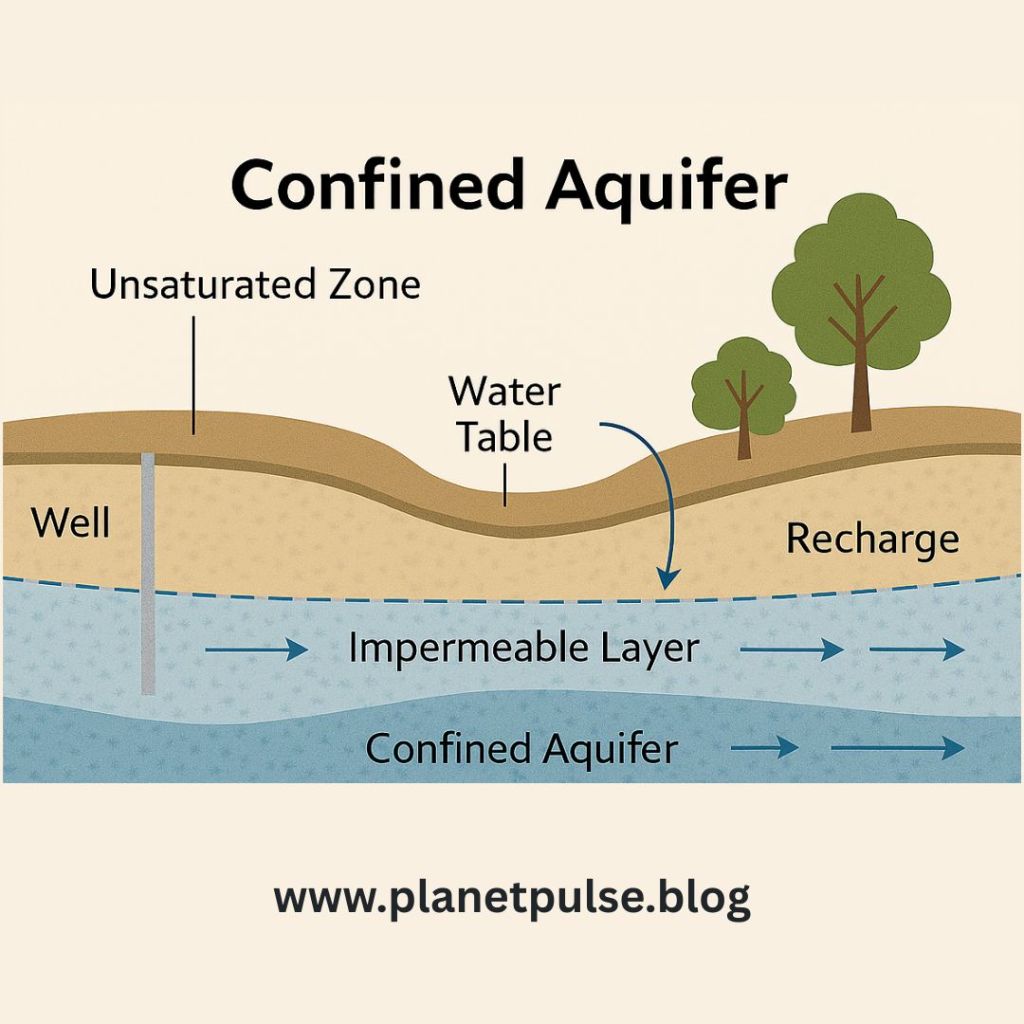
An aquifer is a dynamic geological system that both stores and transmits water. Aquifers vary widely in size, depth, and composition, yet they can typically be classified into three primary categories, such as unconfined, confined and perched aquifers.
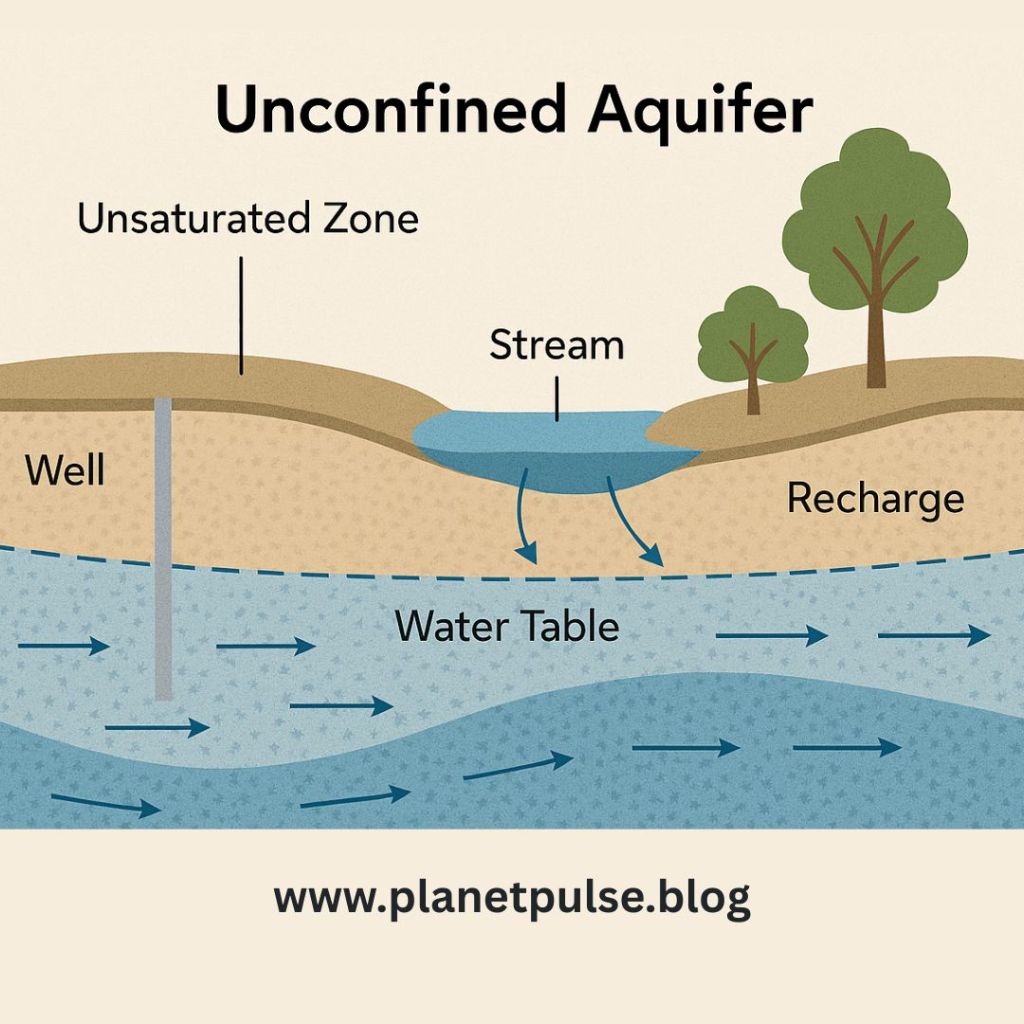
Unconfined aquifers, located just below the ground surface, and is recharged by rainfall, rivers, and melting snow. Due to their exposure to the surface, they react quickly to seasonal changes.
This, however, also increases their susceptibility to contamination from farming practices, industrial activities, and urban drainage. Contaminants that infiltrate the ground can swiftly access unconfined aquifers.
Confined aquifers are trapped between layers of impermeable material such as clay or dense rock. While these layers safeguard the aquifer from surface pollution, they also restrict the rate of its recharge. The water found in confined aquifers can come from far-off recharge areas and, in certain instances, can date back thousands of years.
Due to the pressure in confined aquifers, wells that are drilled into them may yield artesian flows, which means water that rises on its own without the need for pumping.
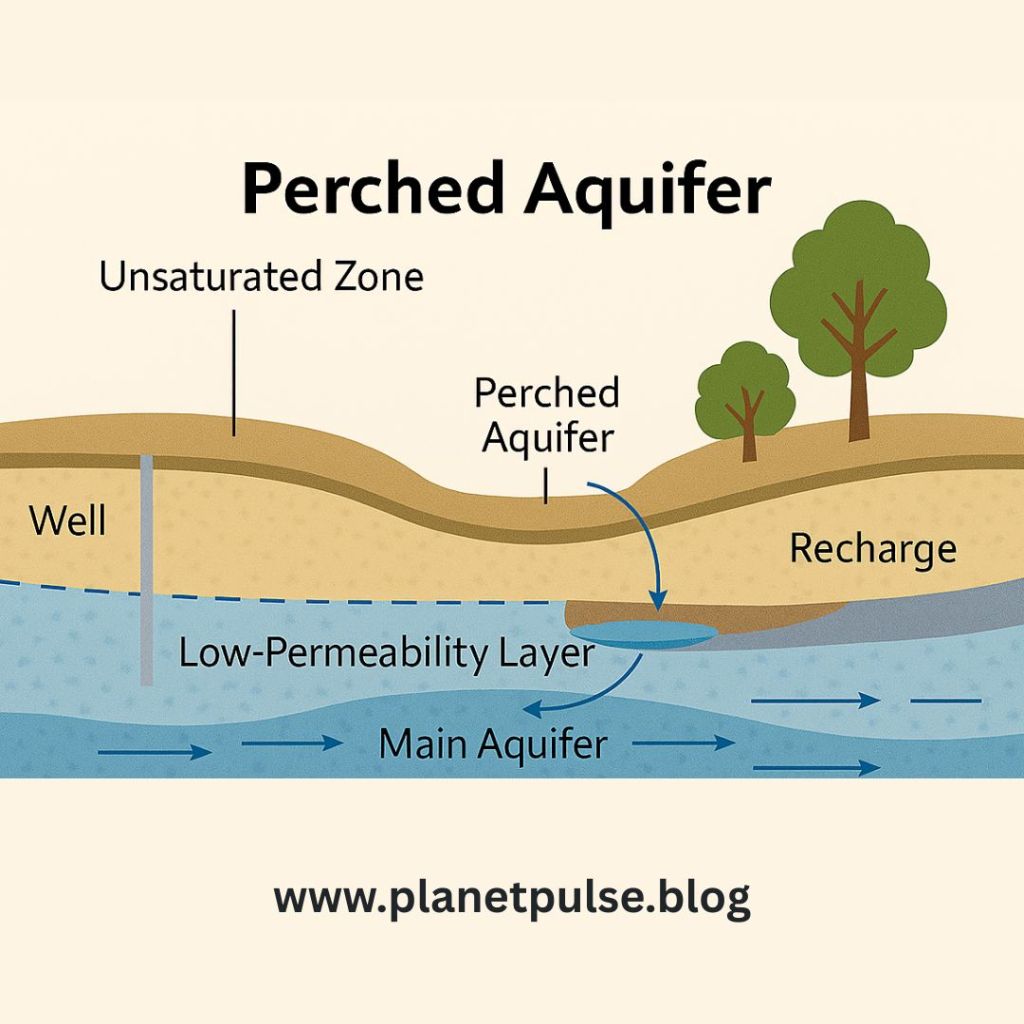
A perched aquifer develops when a minor, impermeable layer in the soil retains water above the main water table.
Due to their shallow and localised nature, these aquifers are unreliable for supplying water on a large scale.
Nonetheless, they can help sustain springs, vegetation patches, and small ecosystems in arid landscapes.
Groundwater Recharge
Groundwater recharge is the process that replenishes groundwater, and it is influenced by climate, soil type, vegetation, and land use. There are 2 main types of groundwater recharge, which includes:
1. Natural recharge:
Natural groundwater recharge refers to the process of surface water moving downward through soil and rock layers to replenish underground aquifers. It starts when water from precipitation, snowmelt, rivers, or lakes seeps into the ground, then moves through deeper soil layers until it arrives at the saturated zone. This occurs more effectively due to a number of aspects:
- Tree-covered regions boost recharge as tree roots form pathways for water to descend and soils with a high concentration of organic matter improve infiltration.
- Rivers and lakes contribute to this process when elevated water levels enable water to permeate through their banks and beds into the aquifers below.
- In mountainous areas, snowmelt offers seasonal replenishment due to the release of substantial amounts of water during thawing.
- Humid regions experience faster recharge due to frequent precipitation and permeable soils.
- Arid regions recharge very slowly because of low rainfall, high evaporation, and compacted soils.
- Some arid‑region aquifers contain fossil water, which infiltrated thousands of years ago under wetter climates and behaves more like a non‑renewable resource.
2. Artificial Recharge
Artificial groundwater recharge is the deliberate process of enhancing the natural replenishment of aquifers by directing additional water into the ground. It consists of gathering surplus surface water, such as stormwater, treated wastewater, or river flows, and directing it into the subsurface using engineered systems. The aim is to enhance groundwater storage, bolster water security, and alleviate stress on aquifers that are being overused. Essential recharge methods include:
- Recharge basins: Designed to allow water to cover large, shallow regions, enabling it to seep into the ground and reach the aquifer below.
- Injection wells: Directly pump water into deeper aquifers when surface infiltration is inadequate or the geological conditions are inappropriate.
- Recharge trenches and pits: Capture runoff and allow its absorption into the ground more effectively than natural infiltration alone.
- Managed Aquifer Recharge (MAR): Diverting surface water and treated wastewater, which offers a dependable source of recharge water throughout the year when adequately purified.
- Collecting stormwater: To mitigate flooding and enhance groundwater storage, particularly in urban environments.
- Supporting overdrawn aquifers: Where artificial recharge helps stabilise water levels and slow land subsidence.
How Groundwater Moves
The hydraulic gradient determines groundwater movement, with water flowing from regions of higher pressure to those of lower pressure. The geological material determines the flow’s speed and direction. For example, water flows rapidly through gravel and sand, yet it moves at a very slow pace through clay or dense rock.
Porosity defines the volume of water a material can retain, while permeability indicates the ease with which water can flow through it. While an aquifer with high porosity but low permeability, like clay, can hold significant volumes of water, its release is gradual.
Due to the slow movement of groundwater, which is often only a few meters annually, contamination can last for decades. Once pollutants enters an aquifer, they can spread gradually, complicating and raising the cost of remediation.
Over‑Extraction: When Demand Outpaces Nature
Over‑extraction occurs when groundwater is pumped faster than it can naturally recharge. This is a growing global issue driven by agriculture, urbanisation, industrial use, and climate change, which can have many negative impacts, including:
Environmental Impacts:
When water tables fall, springs dry up, wetlands shrink, and rivers lose their baseflow, which is the groundwater contribution that keeps them running during dry periods. Groundwater‑dependent ecosystems, such as riparian forests and wetland habitats, can collapse when their water supply diminishes.
Physical Impacts:
One of the most dramatic consequences of over‑extraction is land subsidence. When groundwater is removed, the supporting pressure within the aquifer decreases, causing the land above to sink. In California’s Central Valley, some areas have subsided by more than nine metres over the past century.
Coastal regions face saltwater intrusion. As freshwater levels drop, seawater can move inland, contaminating wells and rendering aquifers unusable for drinking or irrigation.
Socio-Economic Impacts:
Communities reliant on groundwater face rising costs as wells must be drilled deeper. Farmers may struggle to irrigate crops, leading to reduced yields and economic instability. In regions where aquifers cross political boundaries, declining water levels can fuel conflict between users.
Monitoring and Managing Groundwater
Sustainable groundwater management requires accurate monitoring and long‑term planning. While observation wells offer direct measurements of water table levels, satellite missions like NASA’s GRACE identify large-scale changes in groundwater storage by measuring variations in the Earth’s gravitational field.
Groundwater models assist in forecasting future scenarios based on varying extraction practices and climate conditions. These instruments enable those making policy decisions to establish limits on pumping, safeguard recharge zones, and devise initiatives for artificial recharge.
Effective management requires the integration of surface water planning with groundwater considerations. Due to the interconnection of rivers and aquifers, managing them independently frequently results in unforeseen outcomes.
The Future of Groundwater in a Changing Climate
Climate change is reshaping groundwater dynamics. Natural recharge diminishes due to more frequent droughts, and intense rainfall may lead to increased runoff instead of greater infiltration. Saltwater intrusion into coastal aquifers is hastened by rising sea levels.
But groundwater also provides resilience. Being stored underground makes it less prone to evaporation and allows it to serve as a stable resource during extreme climate events. New technologies, ranging from AI-driven modeling to intelligent irrigation systems, provide innovative resources for the sustainable management of groundwater.
Conclusion
Groundwater, although hidden, is an essential element of the global water system. Aquifers support ecosystems, agriculture, and communities, but they face growing threats from over-extraction and climate change. To protect them, we need to understand how they function, monitor, and manage them considering long-term sustainability.



 Planet Pulse
Leave a comment